Archive for April 2012
Tuesday 17th – Friday 20th April: Varanasi
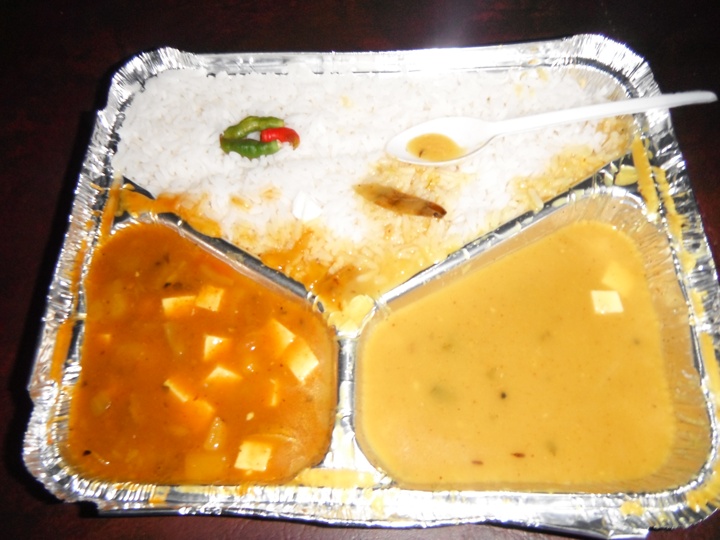
It was an 18 hour train journey from New Jalpaiguri to Varanasi (Mughal Sarai Junction); 22.30 to 16.30 the following day. This was lunch on day 2:

When we finally arrived at Mughal Sarai station we were amused by this advertisement:
 And by this very stylish pink-upholstered rickshaw:
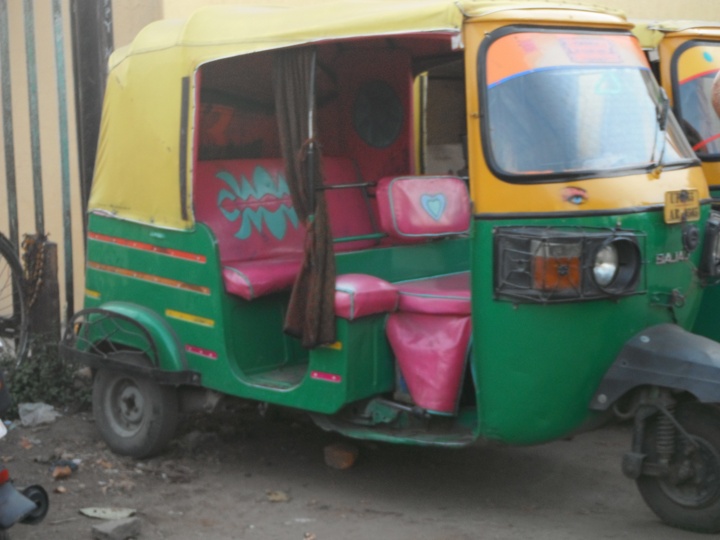
Unfortunately our rickshaw was not quite so stylish but at least he was there waiting for us, procured by the guest house we had booked.
On the way into town we spotted this rather alarming-looking dentists:

Our guest house was the lovely Monu’s Family Paying Guest House:
 Charming and brightly coloured!
After an early dinner at the Dolphin, a rooftop restaurant on the riverside, we had an early night and an early start, as apparently Varanasi is all about morning on the river:
 Dawn at the Ghats, Varanasi
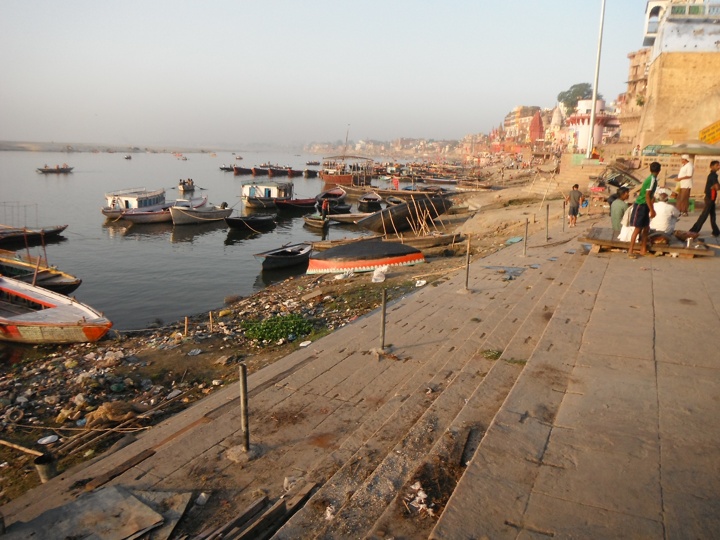 Rubbish at the ghats.
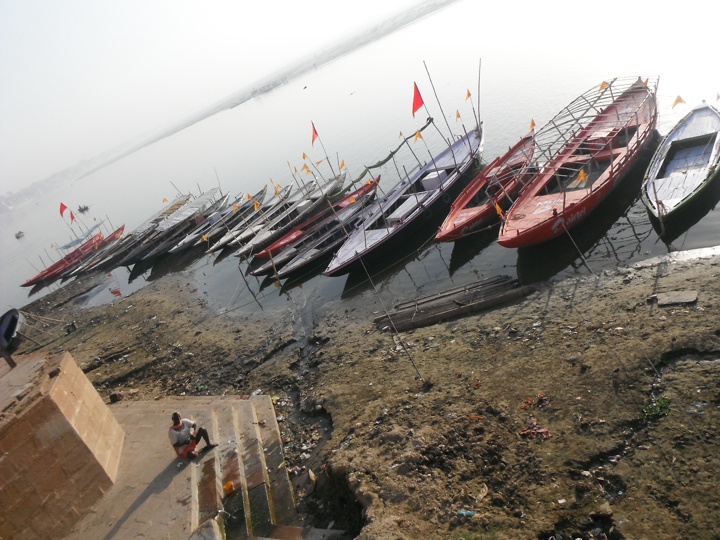 Boats waiting to take tourists ‘for a ride’.

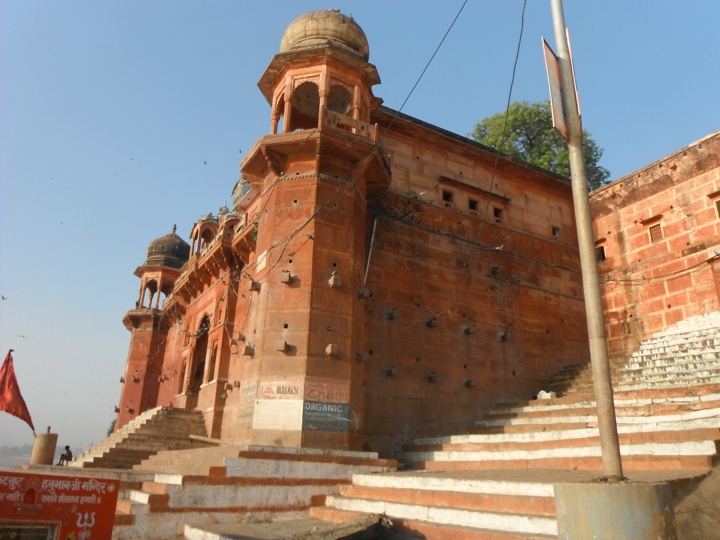 Despite being a hindu holy city, there is evidence of the Mughal period. The city was sacked by Aurangzeb and many of the temples destroyed.
 Washing drying at the dhobi ghats.
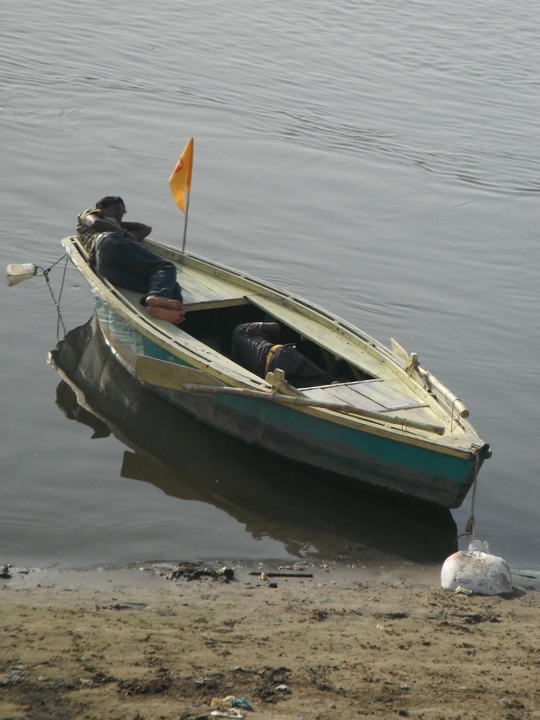 Snoozing in the sun.
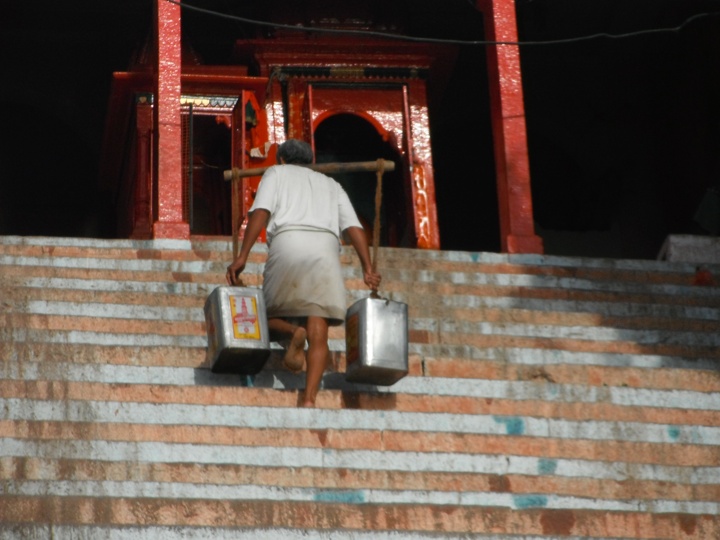 The cruel tutelage of Pai Mei
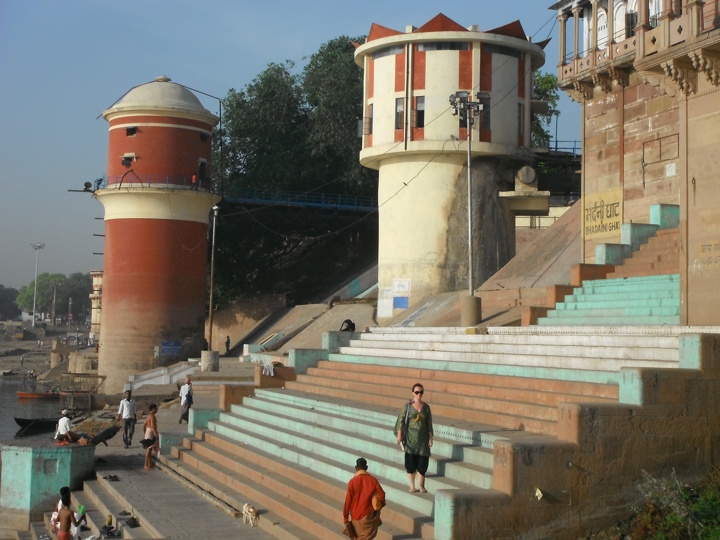 This is one of the ‘Water Treatment Works’ on the river. I dread to think how much ‘treatment’ is needed for this water!
 Local goat.
 Free hugs at Cafe Aum
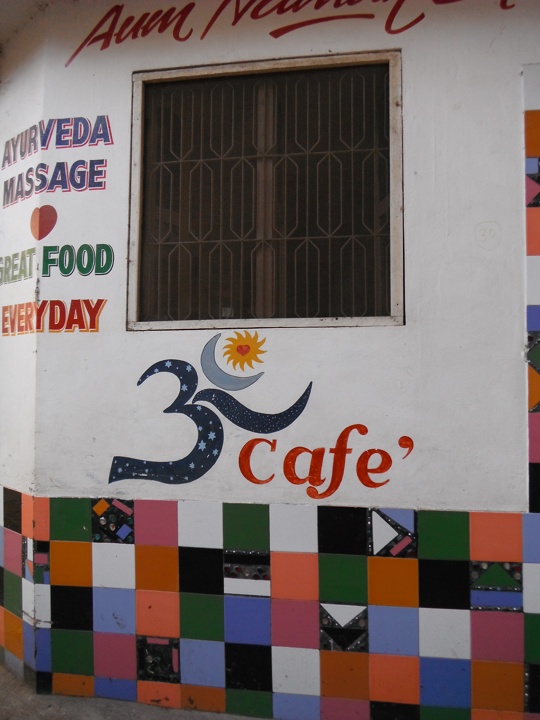 The Aum Cafe, run by an American expat.
Varanasi is a hectic city; although it is known for silk weaving, the main ‘industry’ is pilgrimage and associated tourism so there is stiff competition for the tourist rupee. The narrow (sometimes Randall had to walk sideways!) alleyways of the old city are packed and filthy with litter, cow dung and pester-y people and the whole place is just generally grubby…all the slight cuts, scrapes and insect bites we had got infected over the couple of days, and the woman who runs the Aum cafe told us that e coli and salmonella are rife which didn’t surprise us.
For a bit of relief we headed to one of the nicer hotels to use their pool and wifi, and ended up staying until the evening, so got to see this crazy Indian wedding going on in the courtyard:


The on the rickshaw-ride home we saw several processions for slightly less grand versions – it’s the season for it, apparently:
 Trumpets, drums and light-sabers seem to be the order of the day for weddings in Varanasi.
The next morning we rose somewhat later and had a leisurely brunch in the Brown Bread Cafe, a bakery and restaurant that supports the Learn for Life NGO school:

On our final day we had another early morning and, along with Tom the Australian from our hostel and another couple picked up from a different hotel, we took a boat ride on the Ganges at dawn:

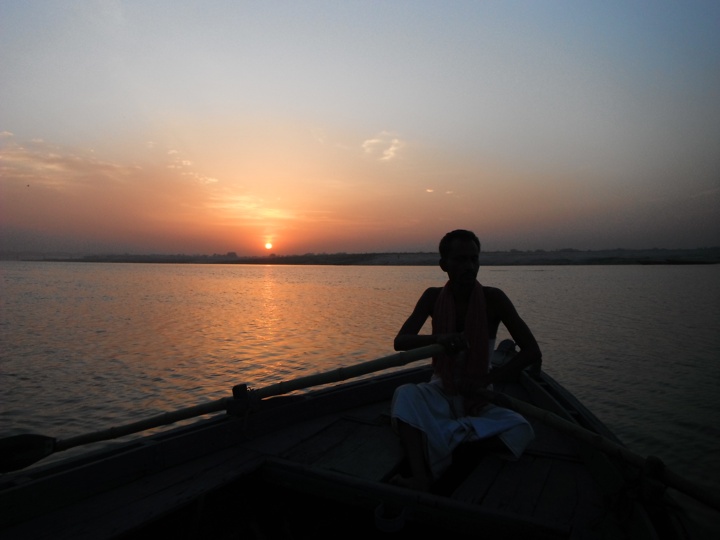
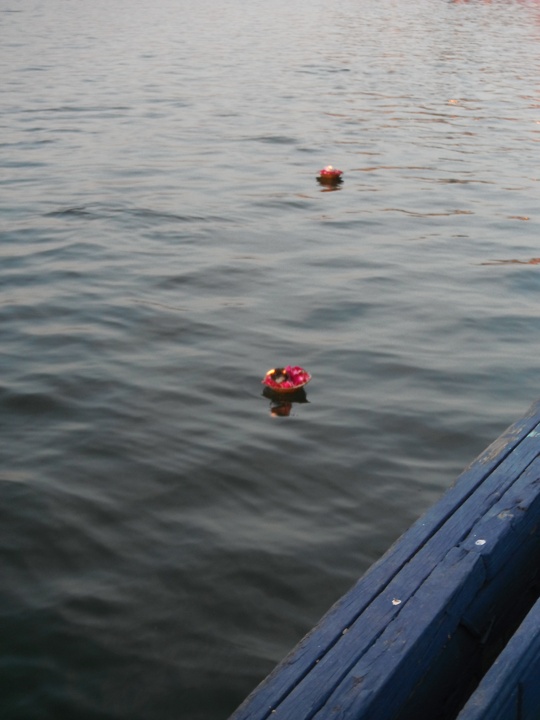
We lit flower-filled paper lamps ‘for our karma’ although as a couple of them nearly set fire to someone’s boat I’m not sure how effective that was likely to be.

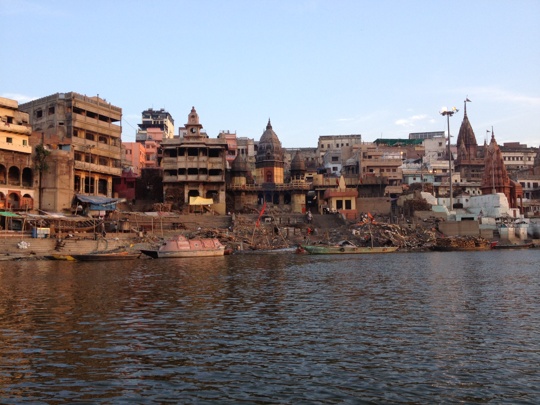
Along the river we passed the famous ‘burning ghats‘ where a cremation apparently frees one from the cycle of death and rebirth. We’d expected something a bit grander – they were actually pretty sordid:
 Piles of wood and piles of ash at the burning ghats.
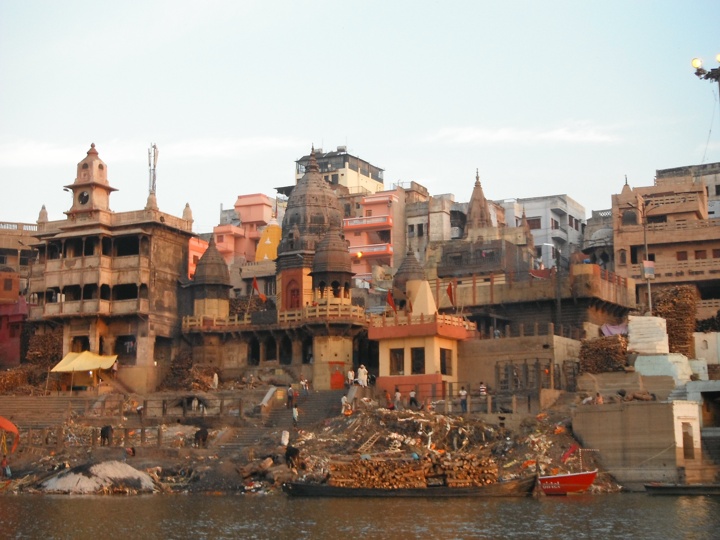
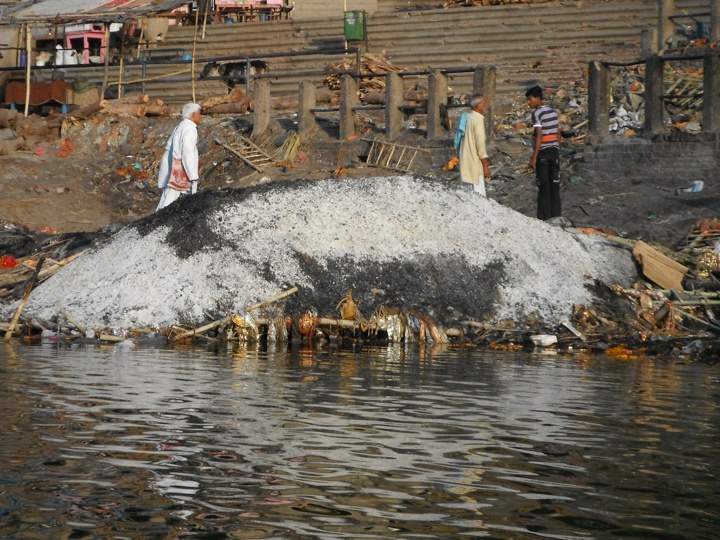 A pile of ashes. Note the rubbish and wandering animals.
The sinking temple raised a smile:
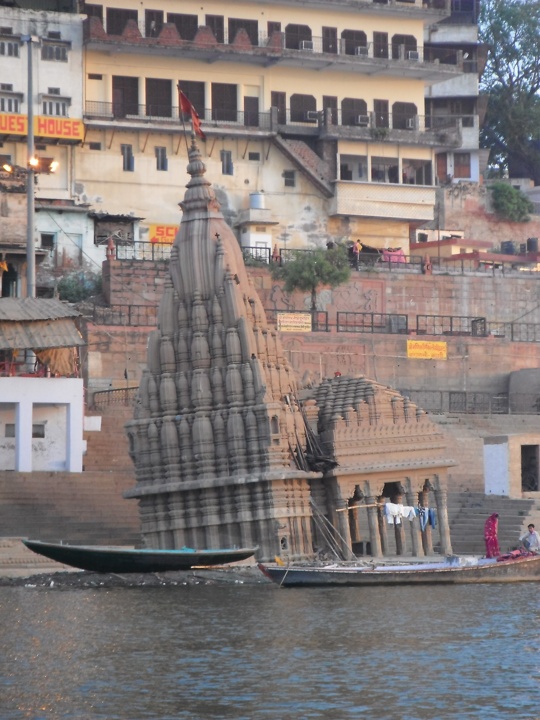
More interesting buildings on the riverside:

 A Sadhu doing his makeup
 Crazy busy ghats – all human life is here:

Finally it was time to catch the overnight train to Agra, leaving mid-afternoon, allowing for cow-hazards:

The rest of the photos are here.
Saturday 21st – Monday 23rd April: Agra
Agra is not really a place one wants to linger – it’s hassle-y and doesn’t have much to recommend it except the standard tourist sights, so we planned to get in and out in two days.
We arrived on the train in the morning, checked in to our hotel, and headed out for breakfast at a nearby rooftop restaurant with views of the Taj:

After a hearty breakfast and showers we headed out to tourist item the first: Agra Fort.
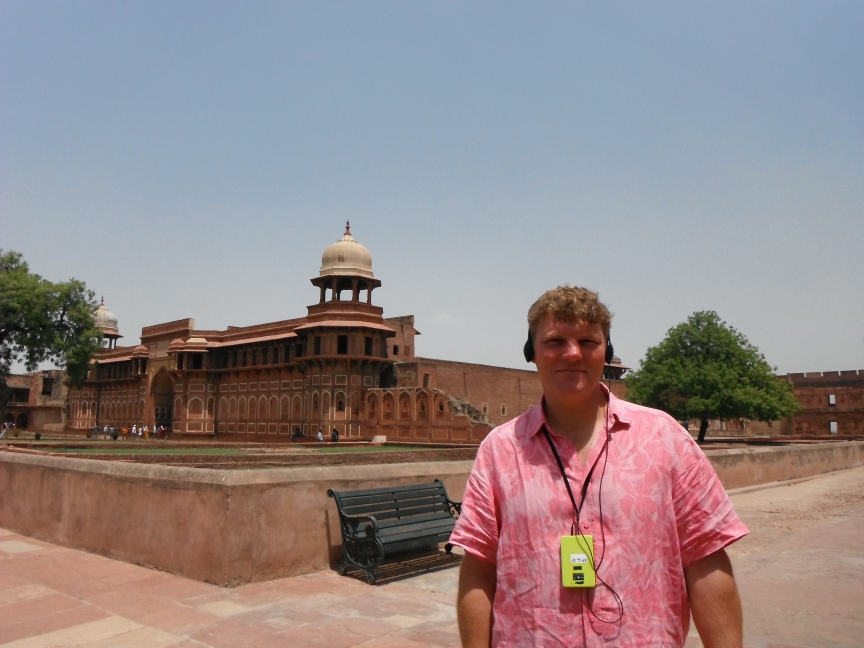 Randall near the entrance to the Agra fort.
 Looking over at the Taj Mahal from the fort
 A baoli or step-well, also used for chilling out (literally) in the summer – note the little cubbies for sitting in. Goes down 25 metres.
 Courtyard in the Agra Fort
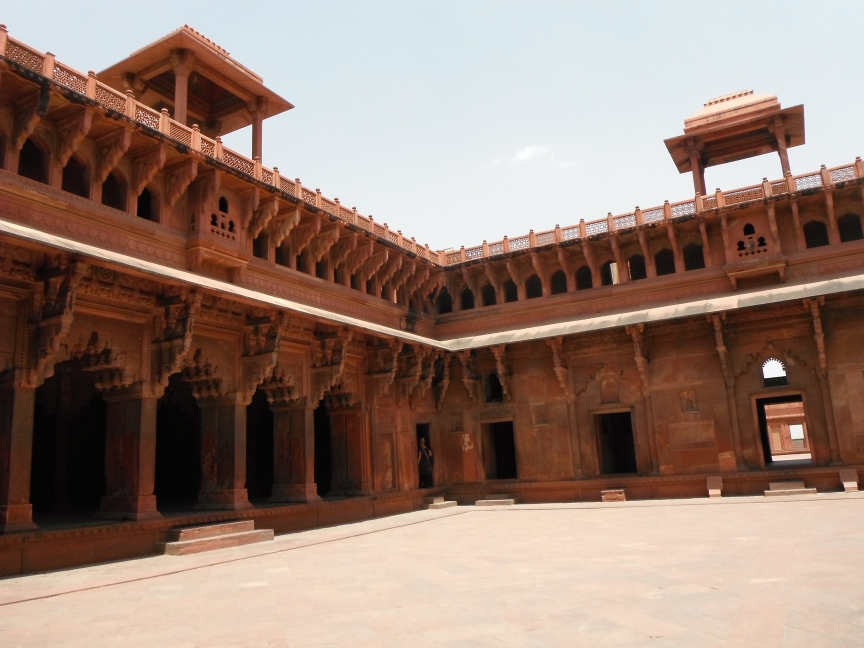 More courtyard
 Carved stone detailing
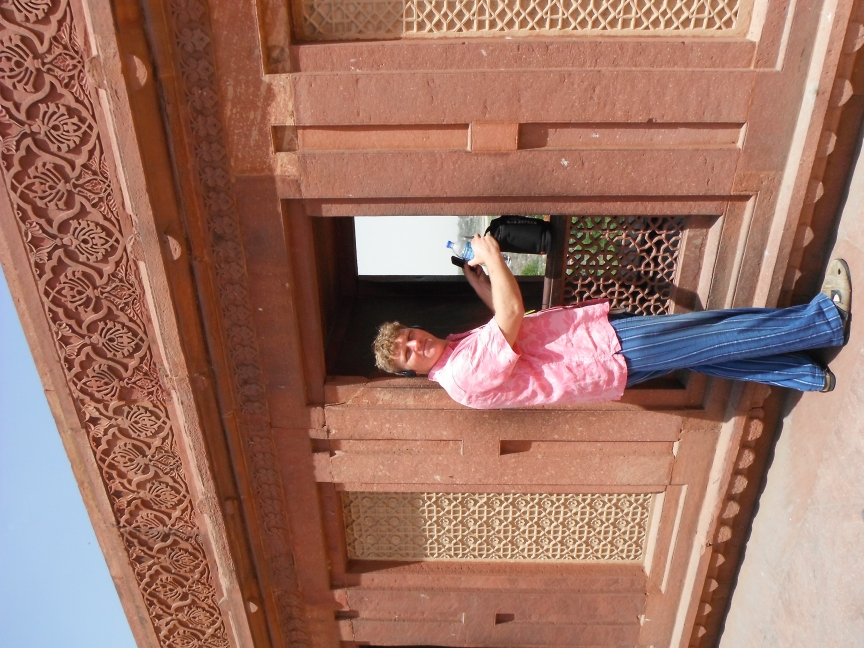 Looking over at the Taj Mahal
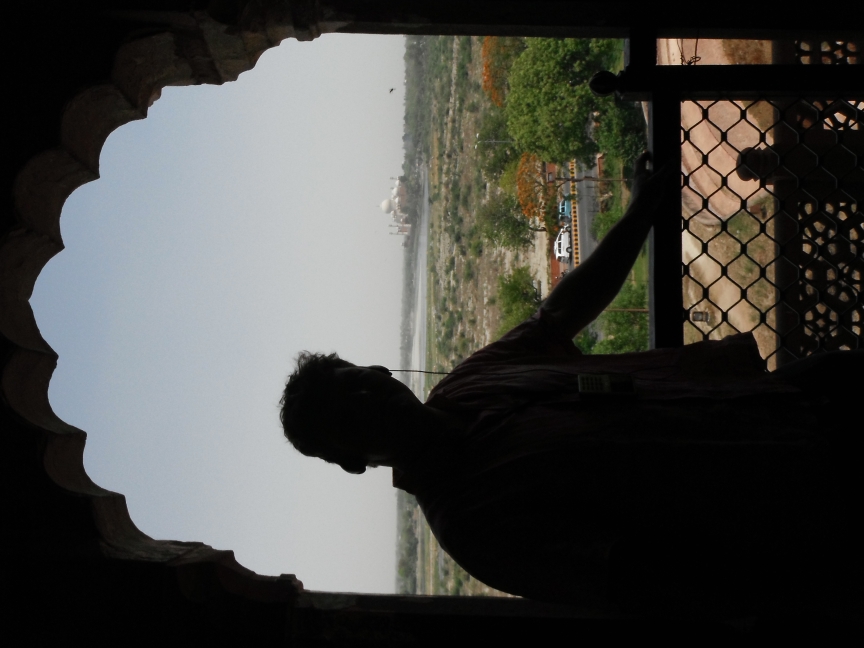 Looking over at the Taj Mahal
 Looking down from the marble pavilion to the Char bagh (Persian-style formal garden)
 Char Bagh
 Marble pavilions and gold domes.
 The Char Bagh again (Char = 4, Bagh = Garden)
 Time to go – it’s getting a bit hot now!
The audio guide was very good – recommended if you find yourself there; also if you go to the Taj first and keep your ticket you get Rs50 off the price of the entry to the fort.

Then it was back to the rooftop cafe for late lunch and a spot of blog writing and Skypage before watching the sunset from the top terrace:
 The top terrace at the Hotel Saniya
 Lunchtime

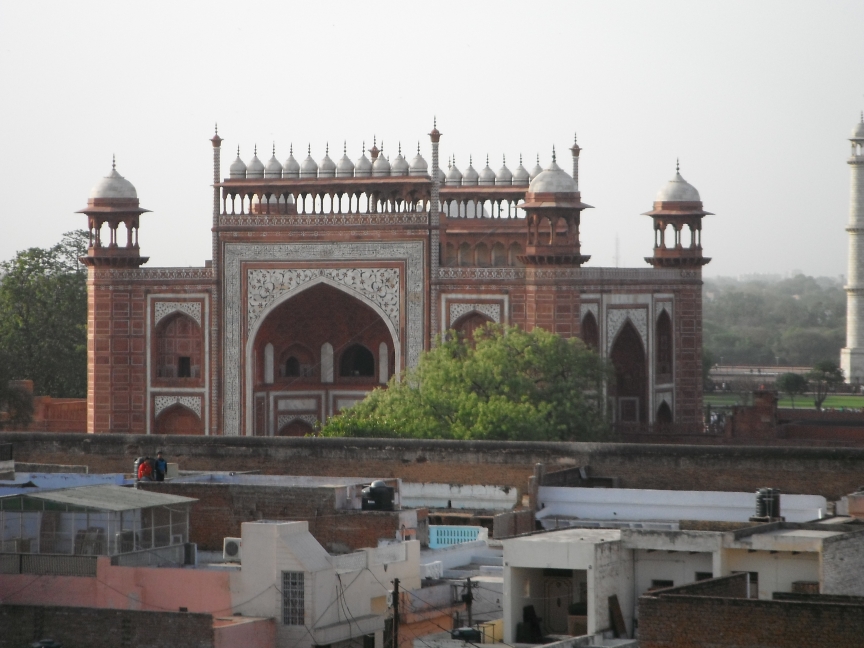 The South Gate of the Taj, taken from the rooftop cafe, looking over the rooftops of Taj Ganj.
 Sunset
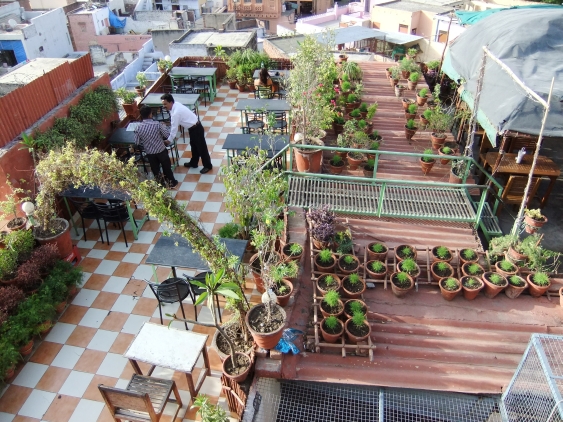 Looking down at the main roof terrace from our VIP top terrace.
 Looking across to the next roof terrace restaurant.
 Sunset
 The terrace at nightfall
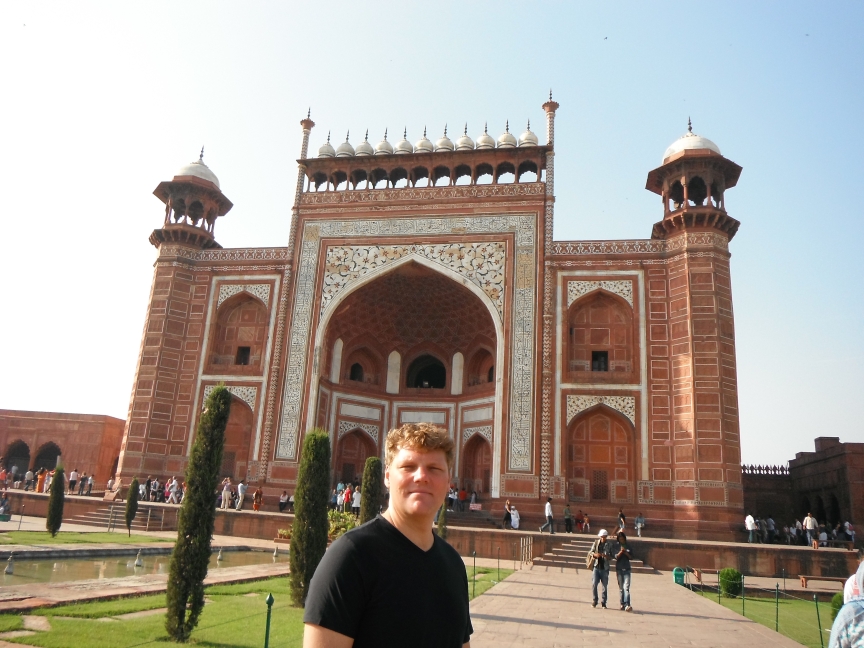
The next day we got up early to be at the Taj for opening time at 6am (not ‘dawn’ as stated on all the published information!). We tried to go to the South gate, but it doesn’t open until 8am so we had to traipse back past our hotel to the West gate. Still, there were no queues at that time of the morning so we were straight in, and here is the main entrance to the Taj Mahal gardens:
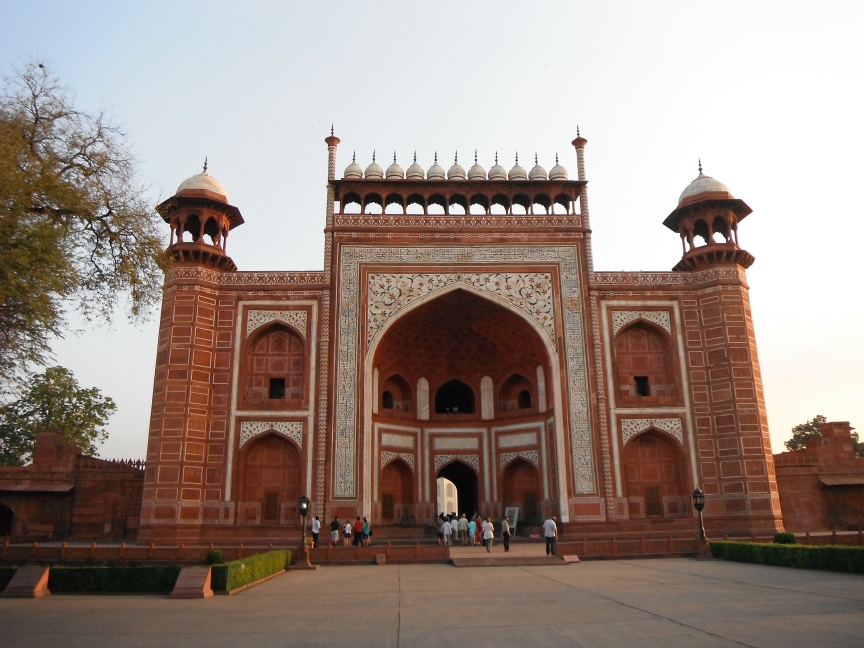
 Looking through the main gate.
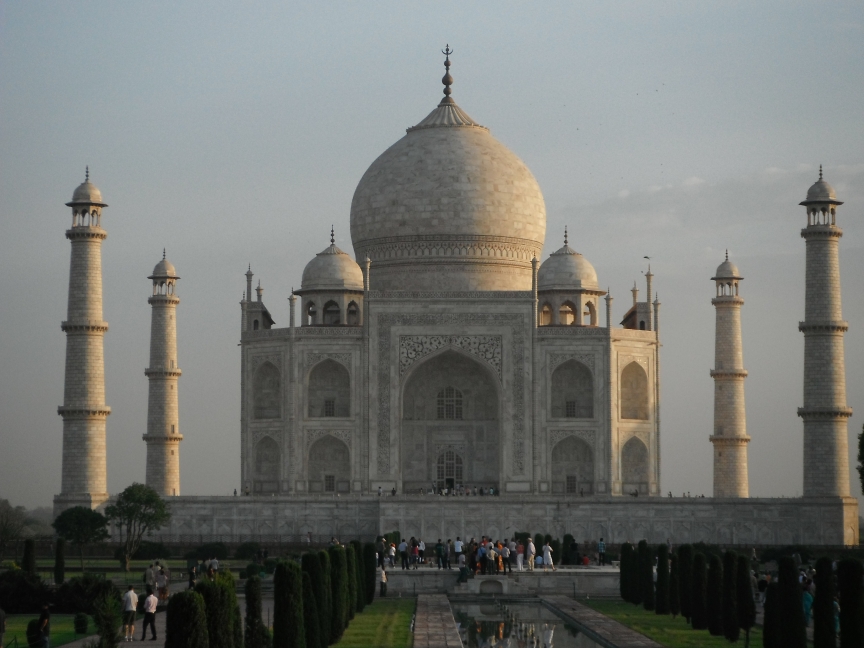 The beautiful Taj Mahal
 Looking back up at the main gate – beautiful calligraphy in stone inlay.
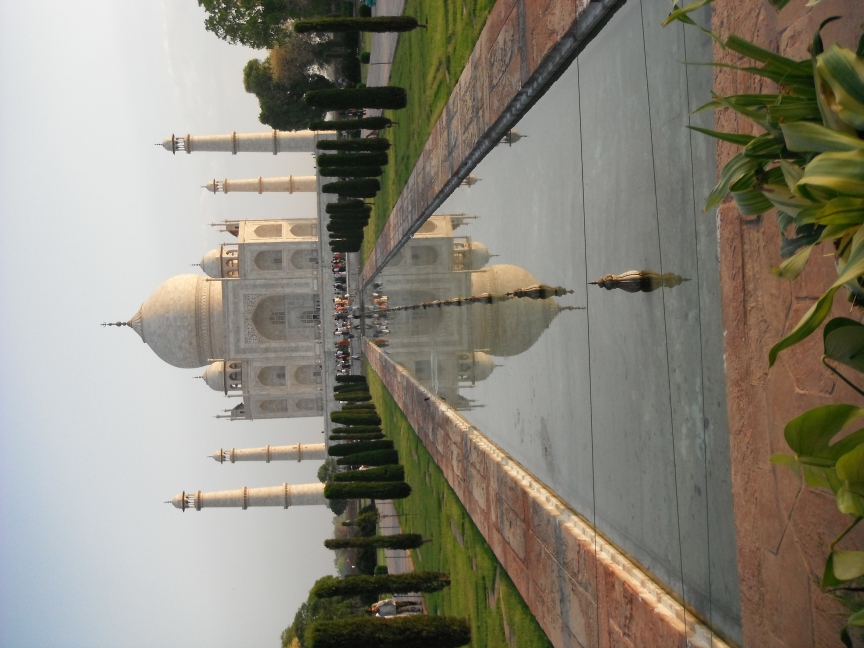 The classic reflection shot!
 The main gate from inside the gardens.
 Aaaaaawwwwww!
 So beautiful.
 Looking at the Taj from inside the ‘dummy’ mosque built to be symmetrical to the real mosque.
 Unbelievably, loads of graffiti by Indians
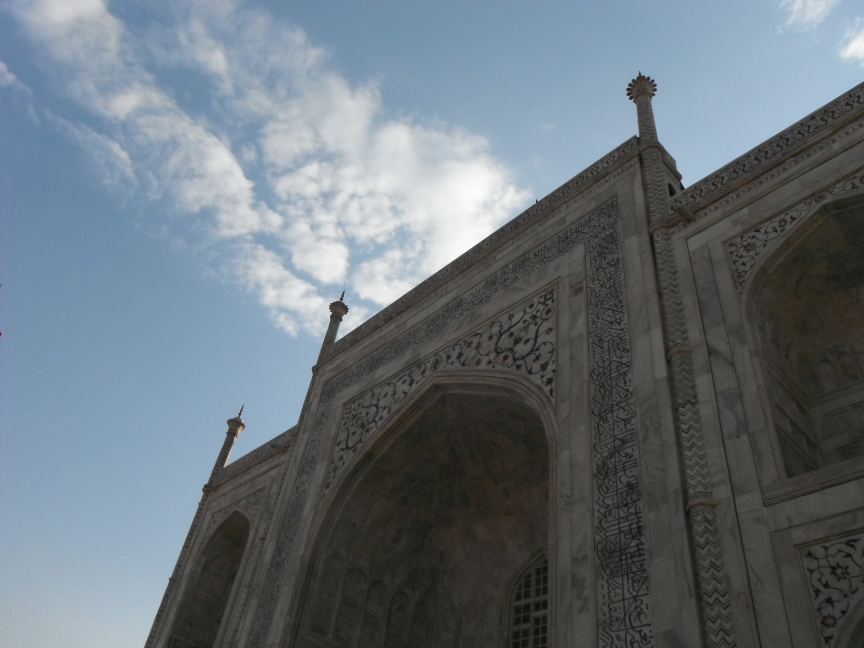


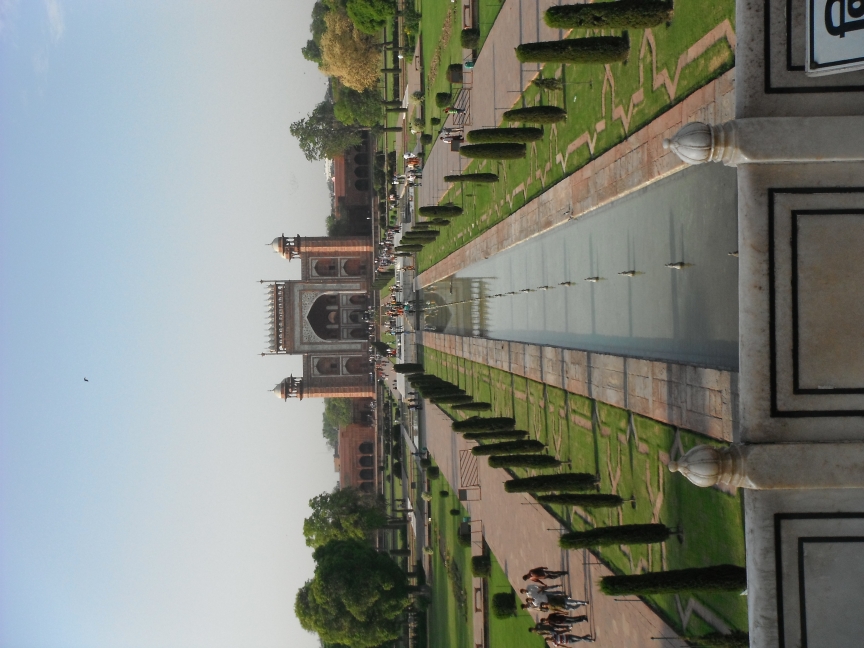
 Inside the mausoleum.
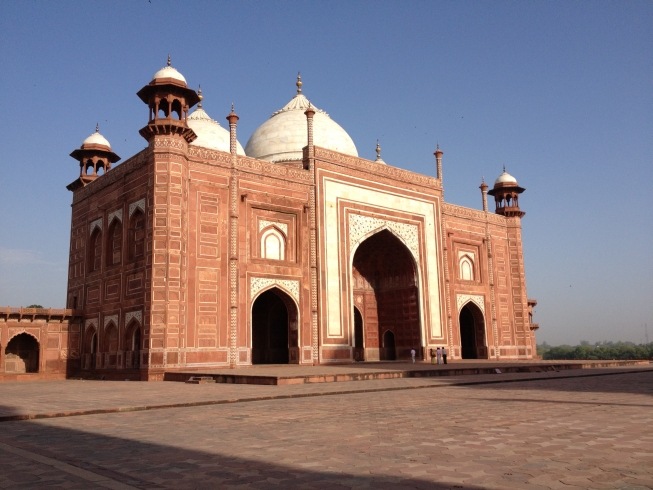 The mosque.

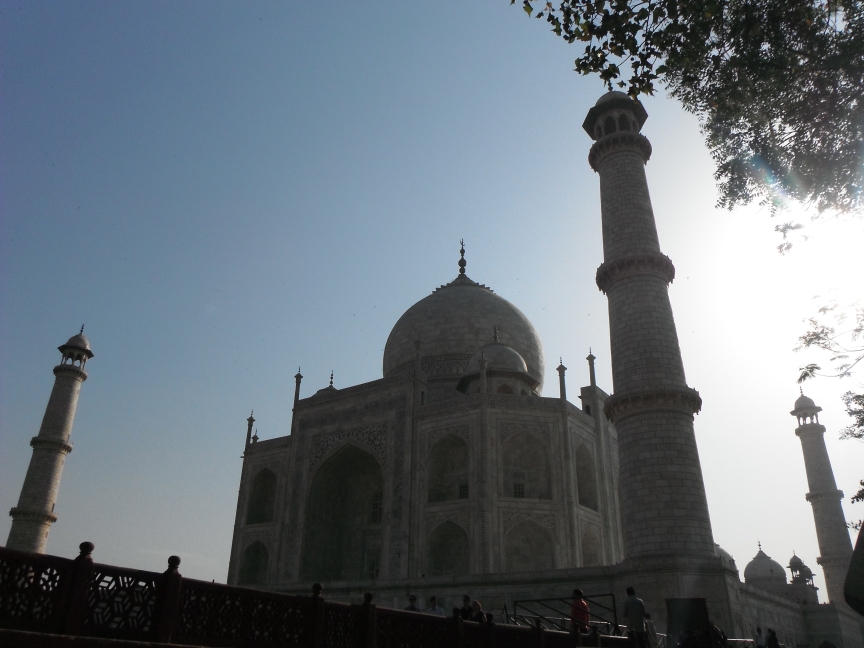
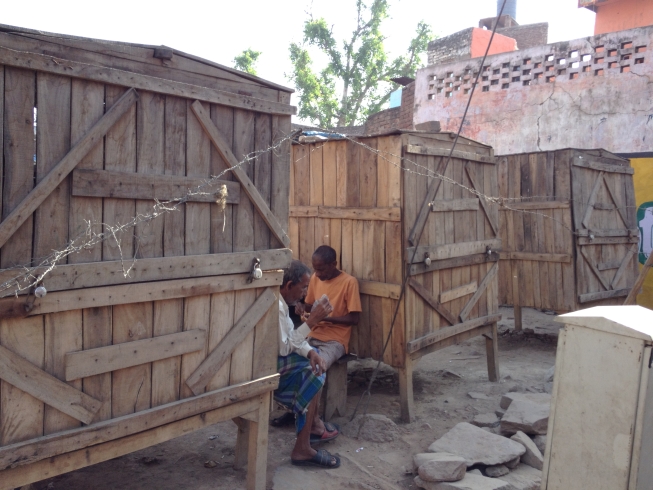
Back in Taj Ganj we were curious about these strange huts, which we think were stalls / sleeping spaces but we never really found out!
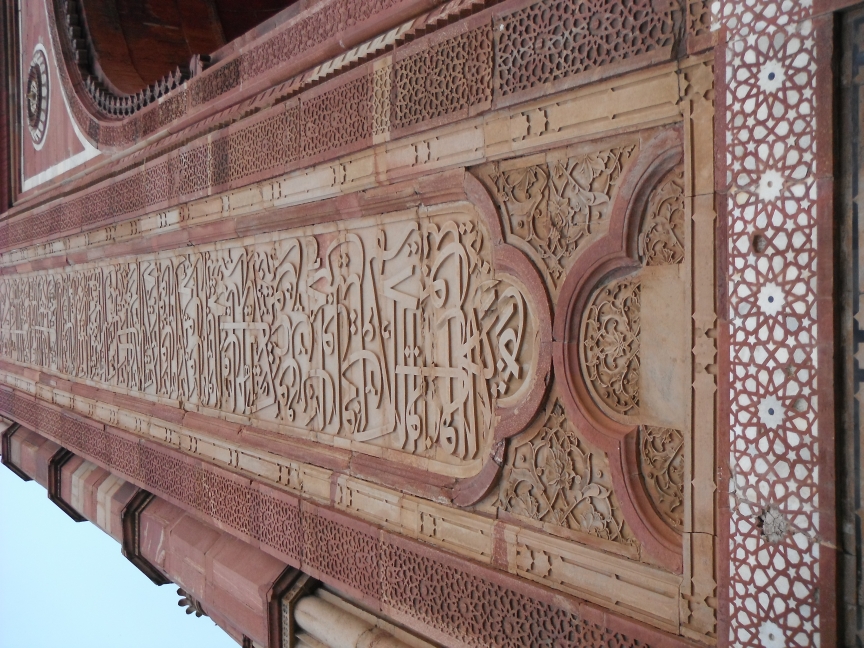
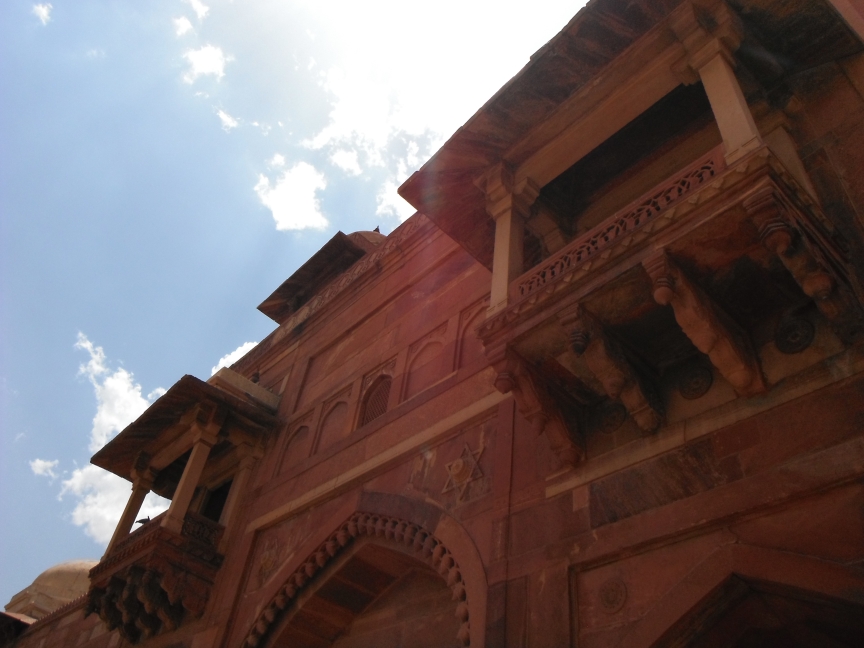
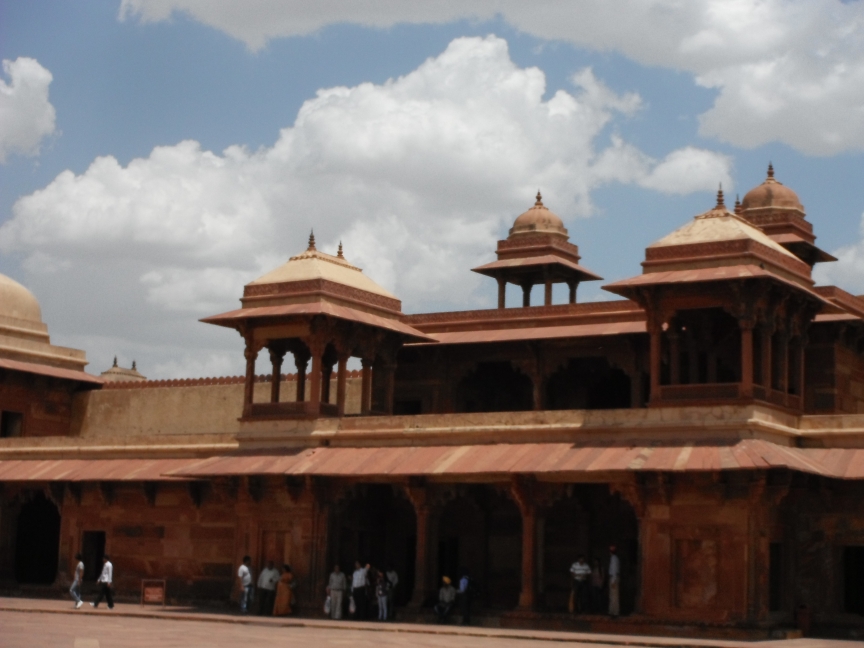
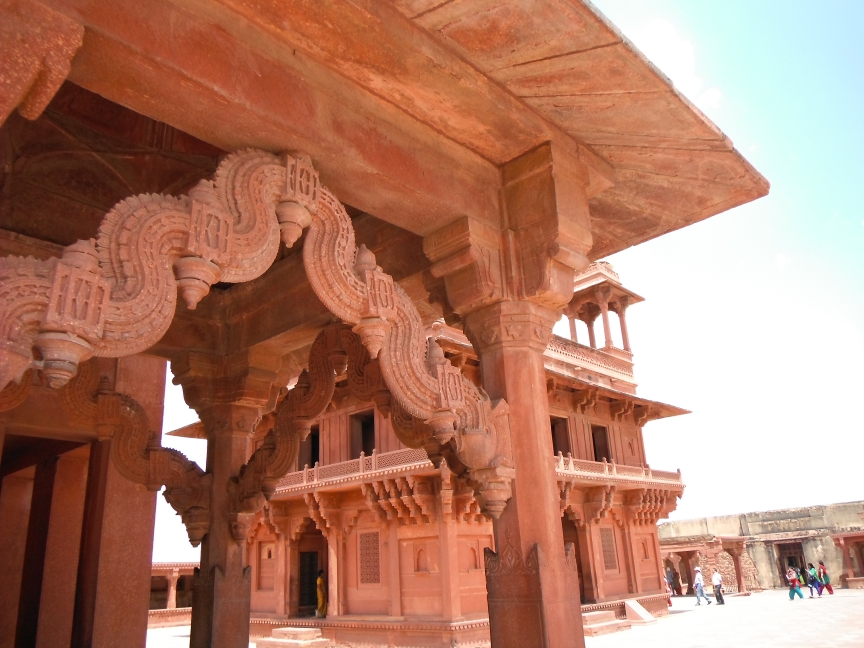
The Fatehpur Sikri (by Randall):
We planned a trip out to the now derelict (but ‘Archaeological Survey Of India’ protected) palace of one of the Mogul Emperors which is an hour’s drive outside of Agra. We negotiated with 3 different drivers to find the cheapest. The price started at 1500 rupees (approx. £20) and we got the all-inclusive trip for 1000 rupees. This is cheap if you work in £s and UK costs which is what most tourist are still doing when they make their very first stop at Agra to visit the Taj Mahal; and what the tourist industry are banking on. To recap, this deal was supposed to be all-inclusive but I’ll first explain what would have happened to a first-timer tourist.
After an hour’s drive the car would stop at a café owned by a friend of the driver who would significantly overcharge for fizzy drinks and the driver would get a kick-back. There is a toll road to the palace complex and the tourist would be expected to hand over 100 rupees for the toll although the toll is actually 20 rupees (the driver would expect the tourist not to notice and to keep the change). At 2Kms out from the palace the car parks are situated (understandably no parking at the palace). The road would be blocked by car park attendants competing to direct the car into their lot, and the tourist would have to pay the parking charge which is higher for foreigners. The tourist would then have to hire a rickshaw (again at inflated costs) to take them the final 2Kms. If the unofficial blockages by the car park attendants didn’t stop the tourist’s car, the Rickshaw union roadblock attended by police would.
(Helen’s note – thanks to all the books I have read set in India and my Indian friends for the tips on how to…errr…tell people somewhat forcefully to go away and engage in congress with members of their family or indeed animals. Or words to that effect.)
 Finally – at the main gate!
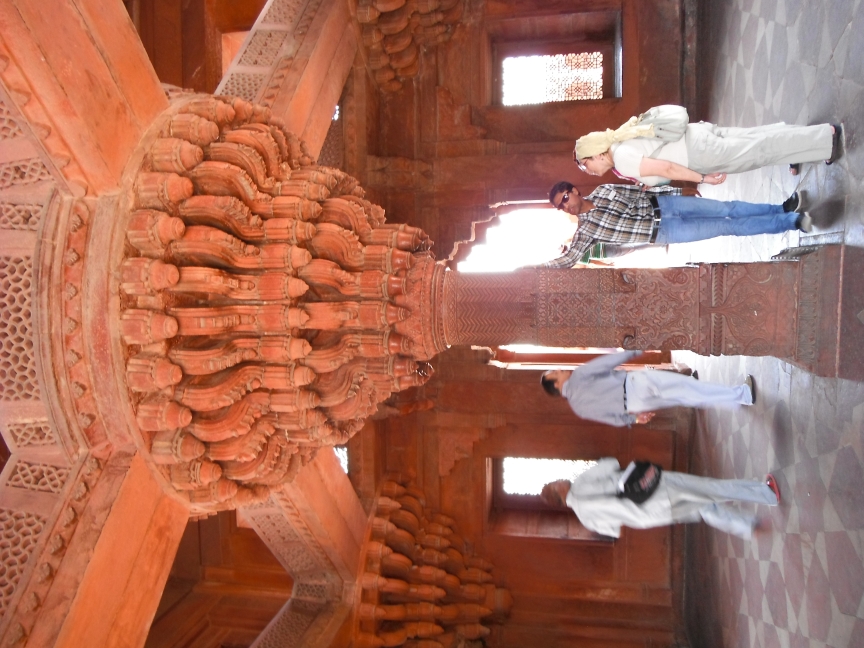
The palace complex (it’s actually multiple palaces within a walled complex) sits on top of a hill in a wide flat plain. The centre of India is hot and dry; actually semi-desert. The Moguls had planted lots of trees around the complex to provide shade and greenery. There are gardens dotted throughout which are still maintained, mostly growing vegetables and herbs. Like much Indian heritage, the palace is bare inside. What you see is the architecture unadorned and the remains of the original mosaics and inlay work. This is beautiful and certainly beats the sometimes gaudy adornments that we saw added to some South East Asian heritage sites. What is missing is information about the buildings and/or any indication of what they would have looked like or how they would have been used. There were little plaques with info – mostly describing the types of architectural detail – against most of the buildings. The info about the building’s purpose frequently did not accord with the info in Lonely Planet so we’re not sure what to believe. The palace is built out of sandstone and features lots of pavilions which we imagine would have been covered in rich fabrics and scattered with cushions. There is a very impressive 5 tier pavilion with ‘secret’ tunnels leading from the Harem. There are drained fountains everywhere and channels that would have carried water as the Moguls knew the cooling benefits of running water. It is a fantastically impressive undertaking to have raised this complex from scratch in the 1500’s. We had a lovely visit and I’d thoroughly recommend it if you have a handy Helen to deal with the scams.

View from the Buland Darwaza gate.




The rest of the photos are here.
Tweet
//
Thursday 5th – Monday 16th April: Darjeeling and the Singalila Trek
After 38 degree heat in Delhi we were looking forward to the cool in Darjeeling, however on the 4 hour jeep trip from Bagdogra airport (on the plains) up to Darjeeling at 2100m it became clear that it was a little more chilly than we had bargained for: 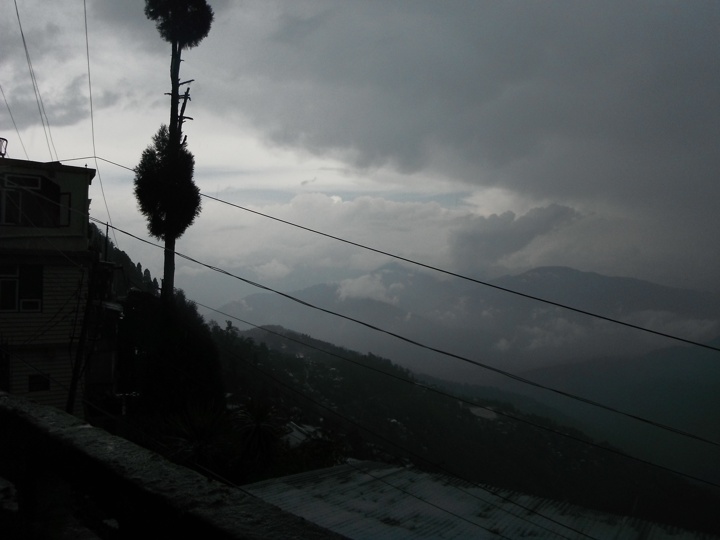
Cloud, rain and thunder accompanied us, and didn’t let up after our arrival, although we did manage to get down to the main square to eat some of the great street food on offer; momos, parathas, omelettes, egg and vegetable stuffed pancakes.

The next morning it hailed, rained and thundered so hard that we were trapped in ‘Sonam’s Kitchen’ by a raging torrent running down the street:
 Taken from the doorway of Sonam’s, looking up the street towards our hostel.
 Hailstones
We spotted paper boats being washed down the street which was quite sweet although probably didn’t help with the major problem of blocked drains that contributed to the localised flash flooding. There was a lightening strike VERY close to us (all those tin roofs!) which may have contributed to the problems we had with electricity, hot water and phone reception over the next two days!
 This enterprising small child made a snowman from hailstones.
 One of the many dilapidated or derelict old colonial buildings.
To be honest we’d expected Darjeeling to be a bit grander, but although there were a few signs of its past as a colonial hill station it is actually pretty down-at-heel and tatty:
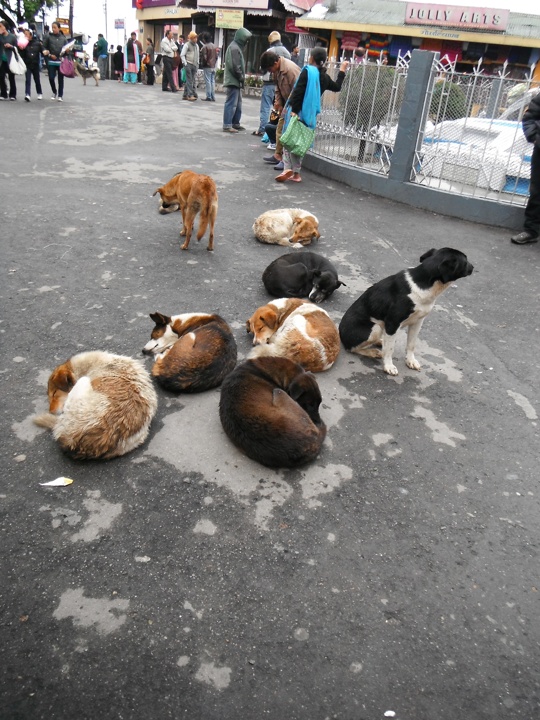 Dogs at Chowrasta, the main square.
After a couple of days of fog, cloud and rain we were actually quite glad to set off on our seven day trek on the Singalila ridge:
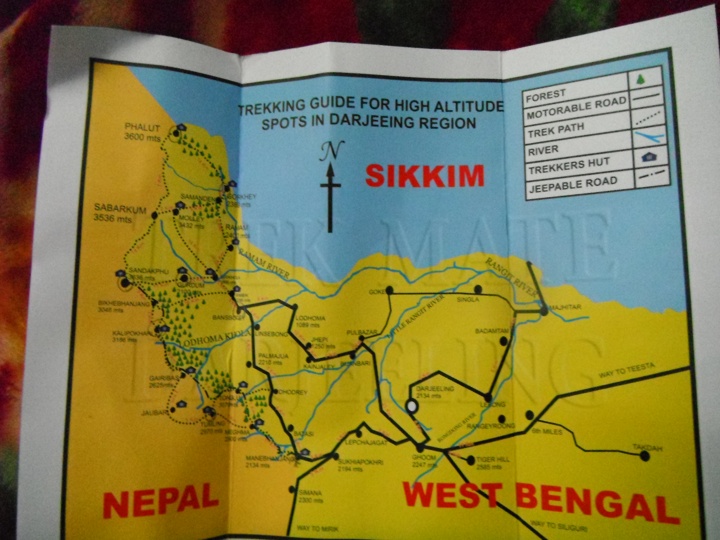 We would be walking along the border of India (West Bengal) and Nepal, and at one point almost into Sikkim.
As we knew the trek would be pretty demanding we had booked a porter, so we bought a cheap but rather excellent rucksack to pack our bits and pieces for the week into. The trekking company we had booked with, Trek Mate, picked us up from our hostel where they introduced us to our guide ‘GD’ and took our big bags to their office for safekeeping, and put us into a jeep for the hour’s drive to Manebhanjan, the start of the trek, where we met our porter.
As the trek trail meanders between India and Nepal we had to keep our passports with us, and to sign in at the start of the trek.
After a steep climb up a ‘jeepable’ road (their term!) we stopped for morning tea near the Chitrey gompa. The locals are a mixture of hindus and buddhists and often we saw temples of both flavours next to each other.
 Randall on front of Chitrey gompa (buddhist monastery)
At lunchtime we stopped for instant noodles and soup and met a couple of young German hikers. Their trekking company had planned a 3 day trek for them, with them covering in a single day what we would cover in our second and third days. This sounded pretty ambitious as our third day was a sharp climb up to the first peak, Sandakhphu, at 3600m.
That night we all stayed in the same trekkers hut, the Shikar Lodge, at 2970m (a climb of 850m from our starting point at Manebhanjan).
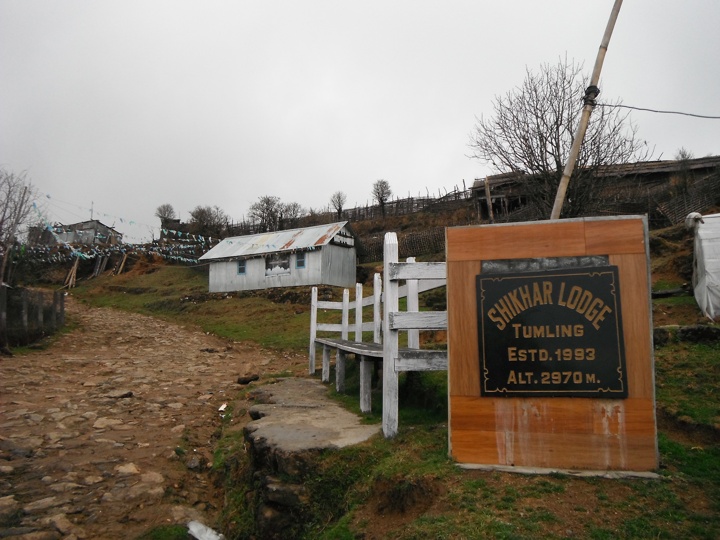
 The path by which we arrived – in the clouds.
The lodge – just on the Nepali side of the border – was run by a huge Nepali woman, and was great:
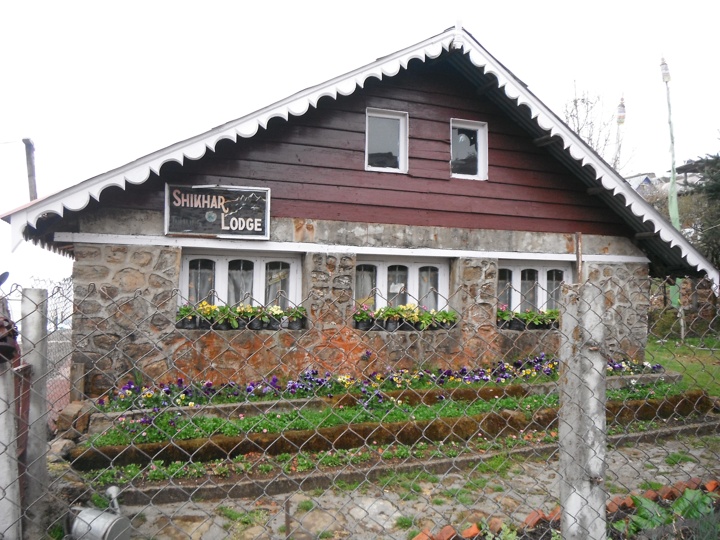 Well-kept vegetable and flower garden
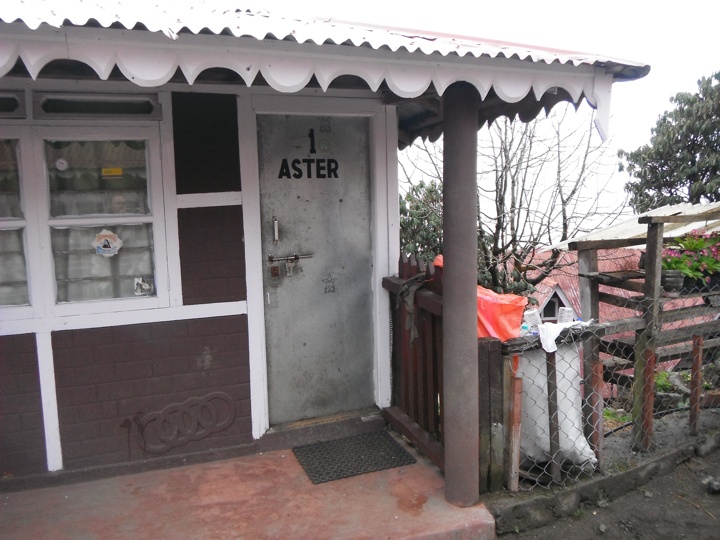 Our room – basic but clean and cosy.
 Slightly alarming frilly pink bedlinen
 Inexplicable tile picture of cowboys and indians in the bathroom.
 Super hearty breakfast: porridge and Tibetan bread
 Cosy common room with open fire
 Locally made honey to put on our porridge.
The next morning we actually entered the Singalila National Park:
 The following poster lists what tourists are supposed to do when entering the park:
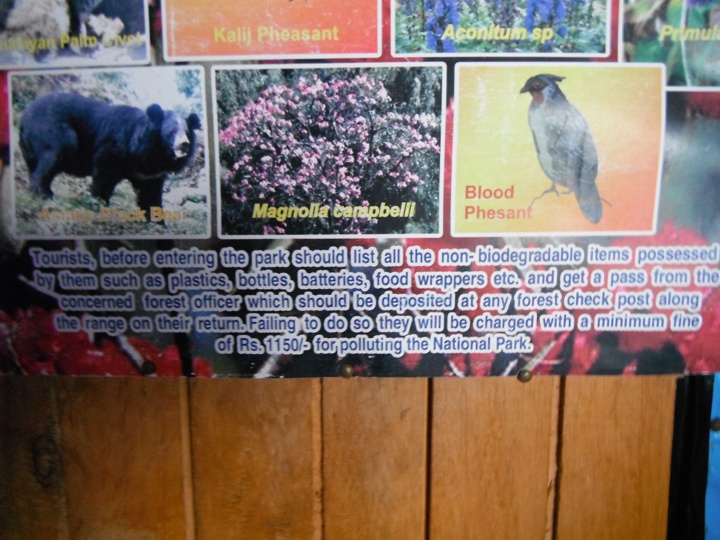 Needless to say we were asked for nothing of the sort.
From Manebhanjan all the way to Sandakhphu peak there was a ‘jeepable’ road that we followed some of the time. While the road provides a vital connection for the people living in the mountain villages, it inevitably means jeep-loads of Indian tourists leaving piles of brightly coloured plastic rubbish in their wake, throwing mineral water bottles out of the back of the jeep as they go, so a bit of a shame from that perspective. GD told us that the guides and porters had been lobbying for the jeep tourism service to be stopped or limited as it obviously affected their business too.
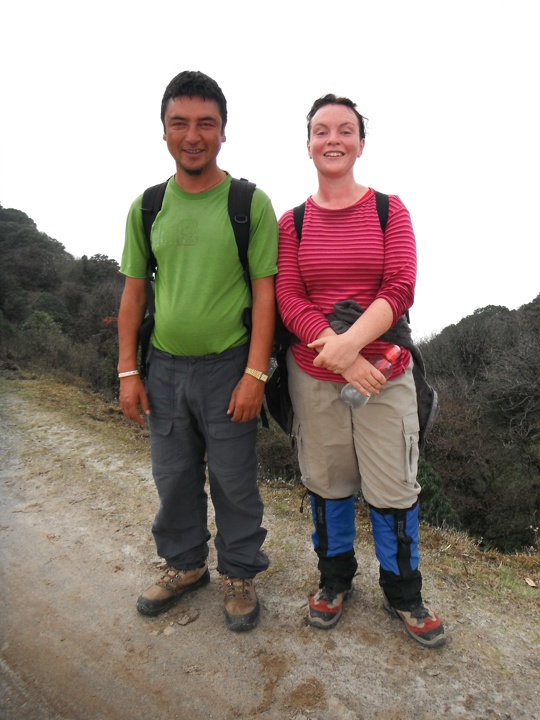 Me and GD
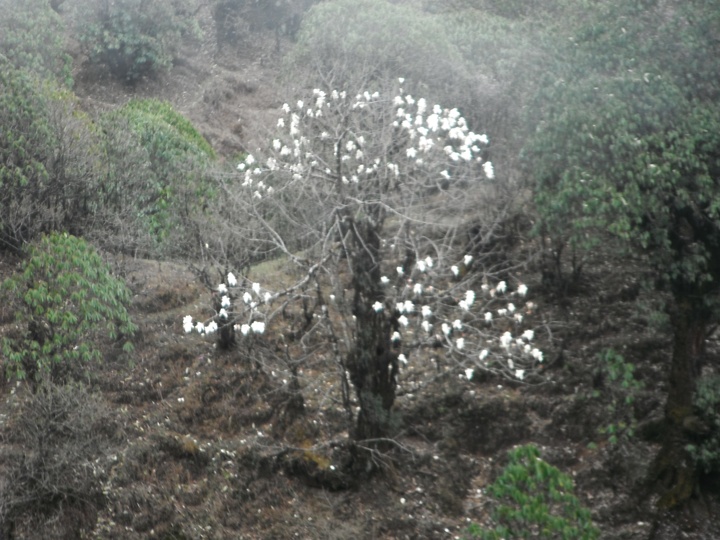 Magnolia tree – we saw these throughout the trek.
 Lunch, day 2
At lunchtime we caught up with Lukas and Theresa, the two Germans. They had started early but slowed down once they had heard that there would be no accommodation available at Sandakhphu that night. Their trekking company had not reserved it, and a number of people there had stayed extra nights as the weather had been bad. As Theresa was feeling unwell this was probably not a bad thing, but not a great reflection on their agency.
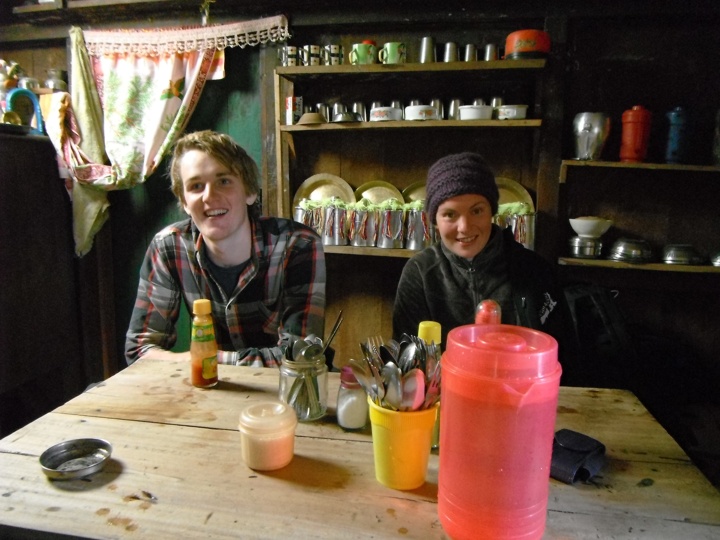 Lukas and I at the lunch table.
We were now into the realm of no electricity except for small solar panels, so we wondered about how the locals kept themselves occupied when there were no tourists to run around after. Mainly with knitting and crocheting in this case as it turned out, as every surface and item of cookware was covered in a cosy or doily:

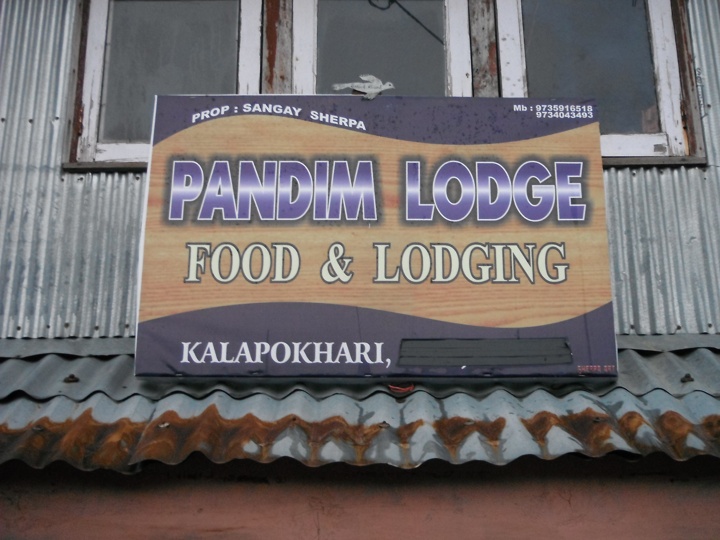
The hostel for this night in Kalapokhri was a bit grim:

Communal toilets and tiny rooms with wooden cots, no fire or heating in the common room, generally a bit miserable.
GD insisted that we tried the local poison ‘raksi’, a fortified wine made with ginger. Brrrrr! He also rather randomly asked everyone’s weight in kgs, and nearly fell off his chair when Randall told his…he then proceeded to tell everyone in earshot. This turned out to be a pattern – everywhere we stopped, GD would have a couple of ginger wines and then tell everyone around him, in three languages, the incredible fact of Randall’s great weight.
That night it poured with rain and hailed – in the morning we awoke to find snow on the mountain top where we were headed:
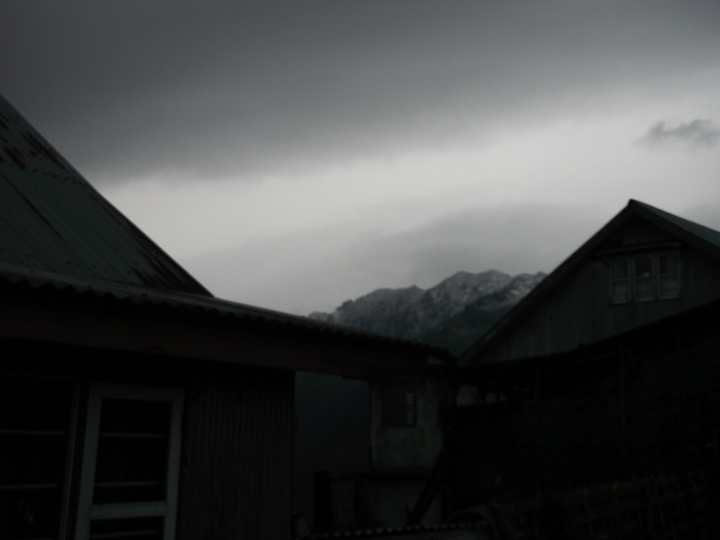 View of Sandakhphu from Kalapokhri, morning of day 3.
We hung around for a couple of hours waiting to see if the weather would improve as we had a short but steep walk: 3200m down to 3000m then up to the peak at 3600m, all over 7km. At around midday we decided to go for it, in full wet weather gear:
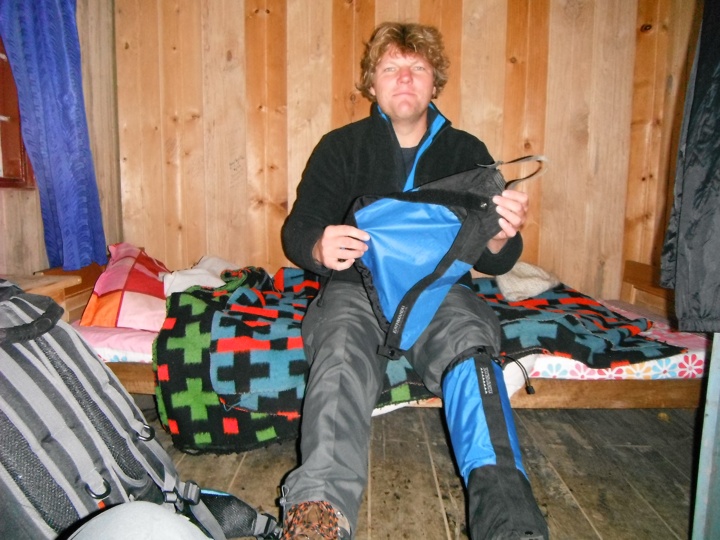 Gaiters and all.
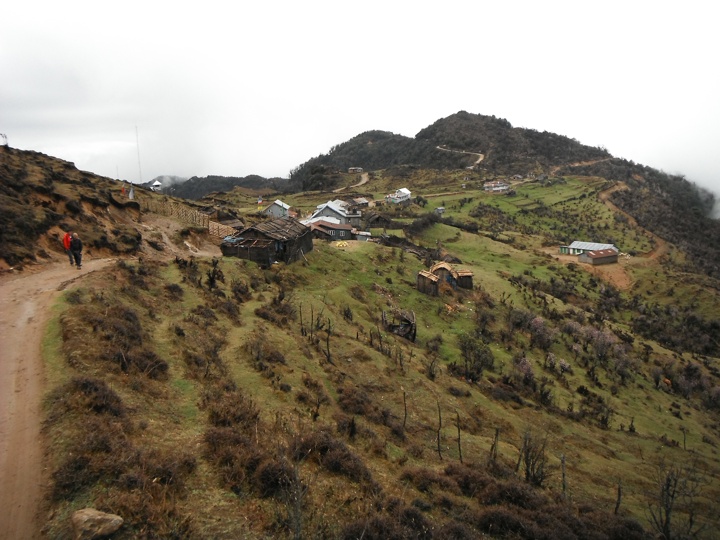 We left the village in relative good weather – this is the view back down to where we had stayed.
The walk was fine – the final 2km were very steep but we stayed dry until the last ten minutes before arriving in Sandakhphu; about half a km away the cloud came down and the snow started!
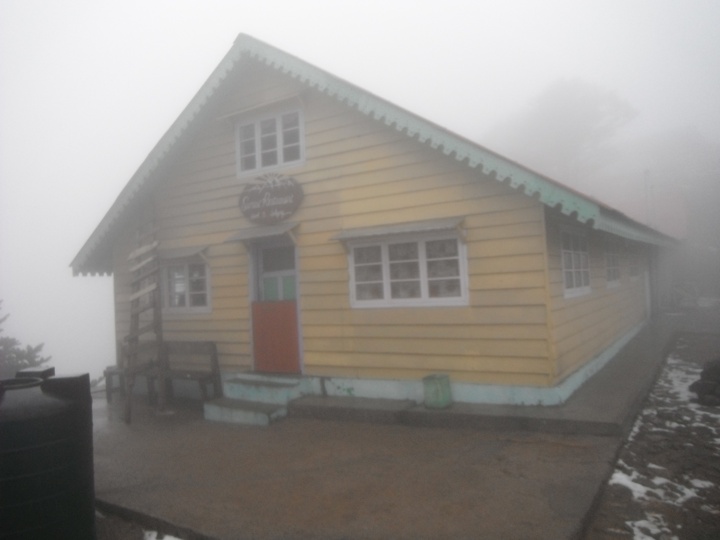 Our hut in Sandakhphu
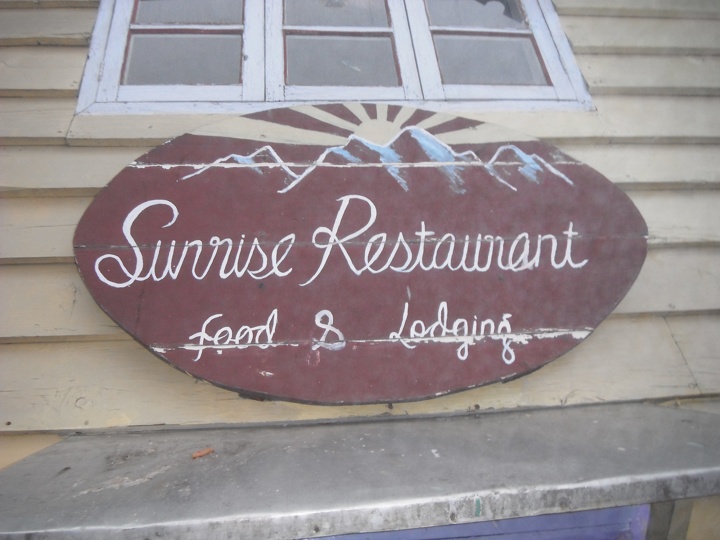
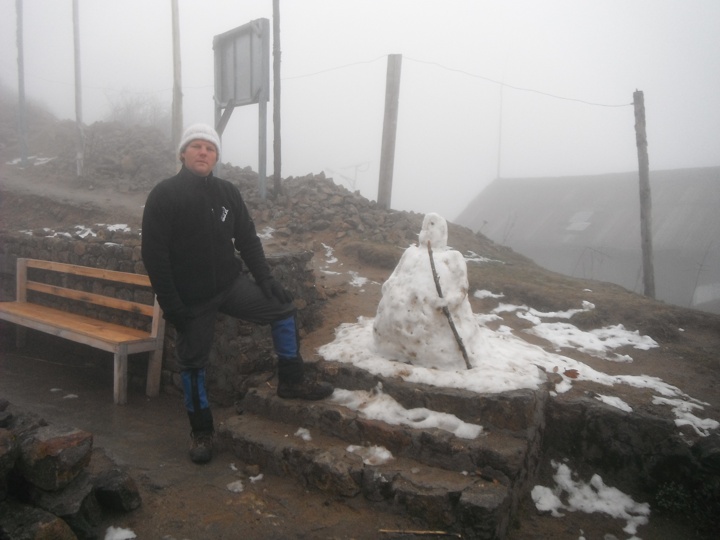 Snowman outside our hut!
The whole point of coming to Sandakhphu and walking the ridge is to see the amazing views of the Kanchenjunga range and Everest, so it was a bit of a disappointment to only have cloud and snow. Still, the next day was a 21km walk along the ridge (although actually quite a lot of up and down!) so we hoped for it to clear at some point.
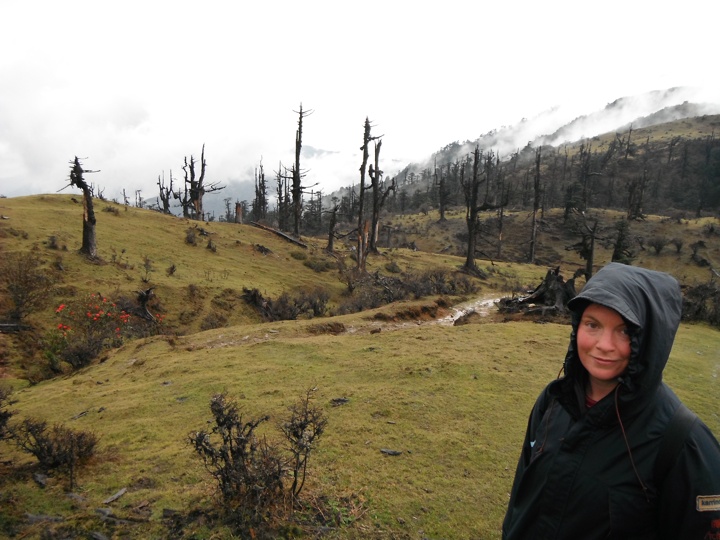 Up above the tree line on the ridge between Sandakhphu and Phalut – pretty wet and cold!
 The long and winding road (trail, anyway)
 Wet, cold, but happy!
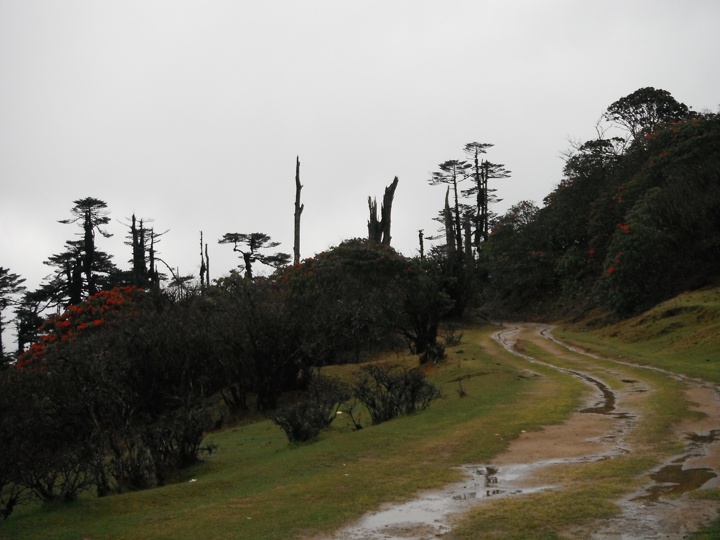 Weaving back into the trees
Once again, we arrived in cloud with no views. The hut stood up to the gale force winds and horizontal hailstones over night with only a few leaks in the ceiling!
The next morning GD knocked on the door to get us to come up to the view point – the clouds had finally lifted, at least partially.
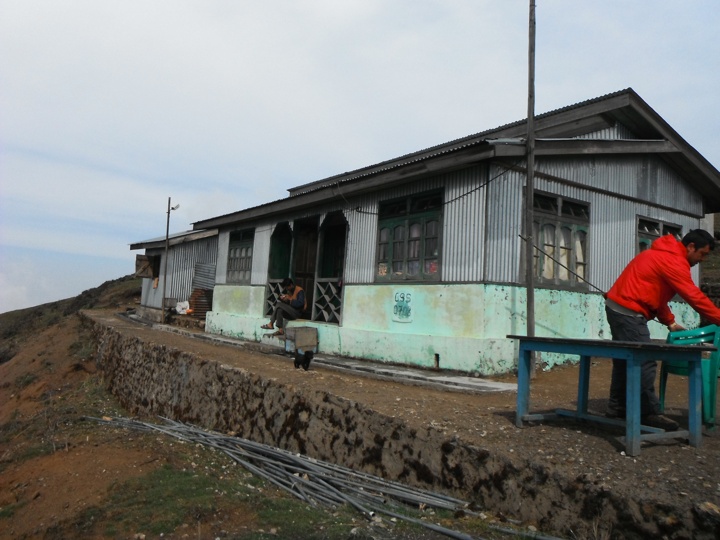 The hut, night 4, Phalut.
 Heading up to the viewing point.
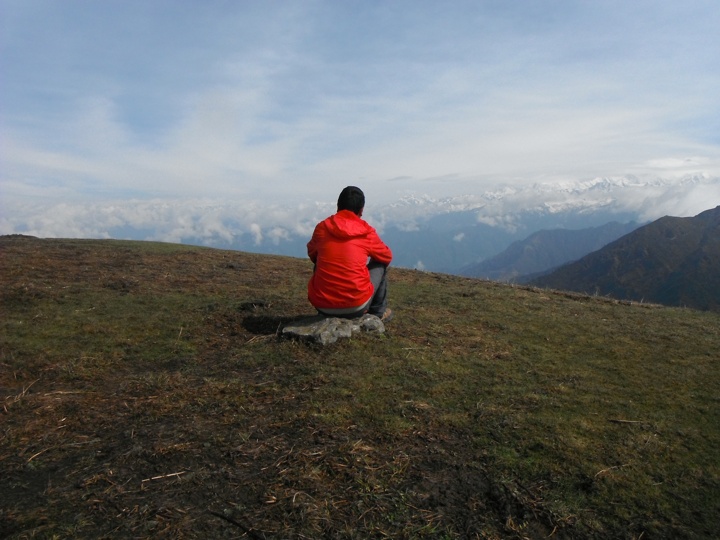 GD looking out at the Kanchenjunga range
Randall trying to spot Mt Everest in the distance between the clouds
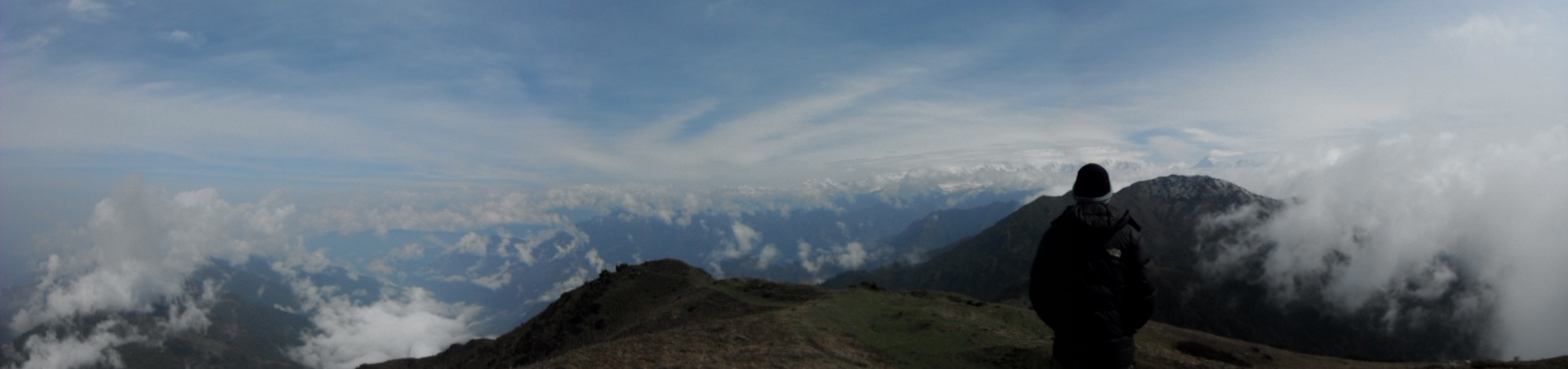 The sleeping buddha formation in the Kanchenjunga range, sadly mostly obscured by clouds!
 Randall and Kanchenjunga (left)
 Brrrr – time for breakfast!
 Yak yak yak…
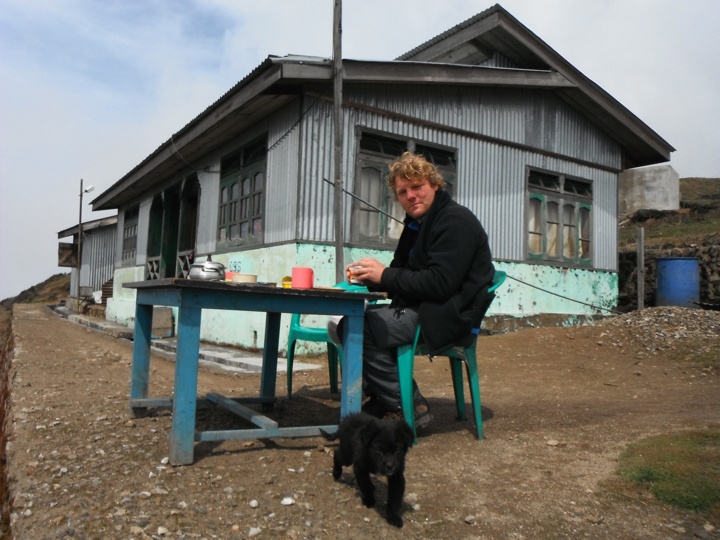 Breakfast in the sunshine! What a treat! Randall feeding his toast to the puppy.
The walking on day 5 was beautiful, not only because we finally had sunshine but also because we were walking down – a descent of 1300m – through lush forest.

 Arriving in Gorkhey for night 5
Our hut on night 5 was in Gorkhey on the border of West Bengal and Sikkim – over the river at the bottom of the valley was Sikkim.
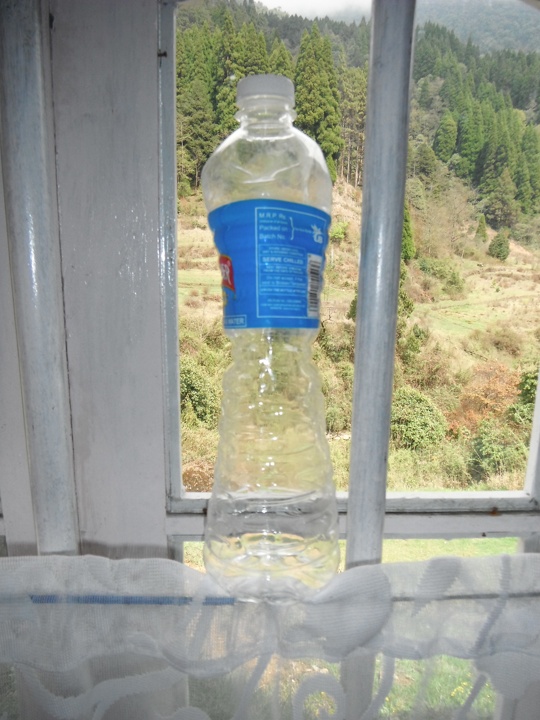 Empty bottle put in our rucksack at 3600m, squashed at 2300m.
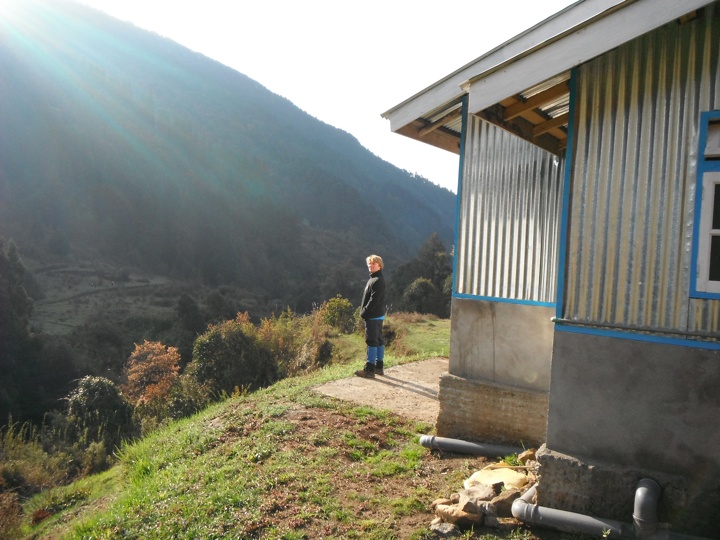 Our hut, looking over the river to Sikkim
 Our hut – the ‘hotel paradise’ 🙂
 Inside the hotel owners’ kitchen where we ate. This is the same concrete/clay fire/oven arrangement we had seen everywhere in the previous three days.
 The view around Gorkhey
 The pretty river running down into the valley
 Day 6 walking – Gorkhey to Sirikhola. Stopped in the yard of a primary school to admire the view across the valley.
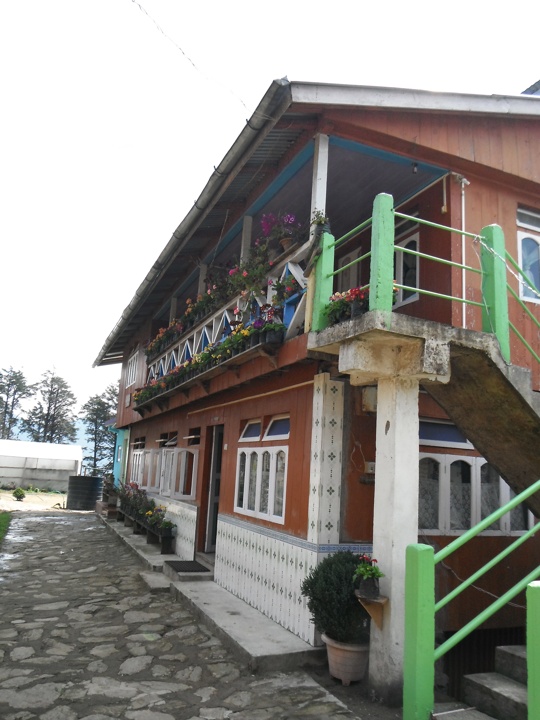 Morning tea break in Raman
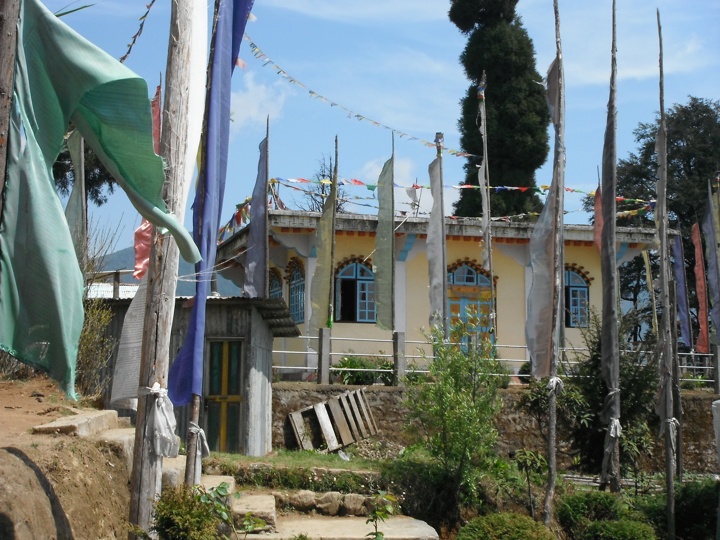 Raman buddhist temple
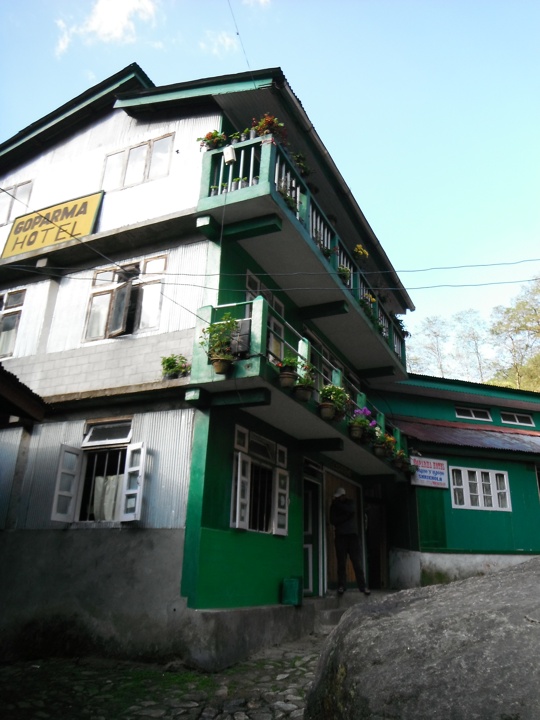 Our guest house in Sirikhola – very civilised.
 Fooding and lodging.
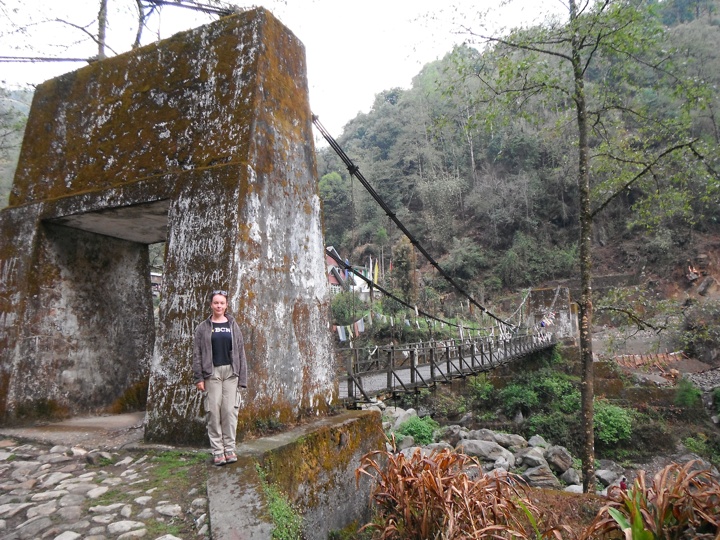
 Bridge over the river at Sirikhola

 Crazy locals ‘fishing’ with bamboo, wire and a generator, trying to electrocute the fish!
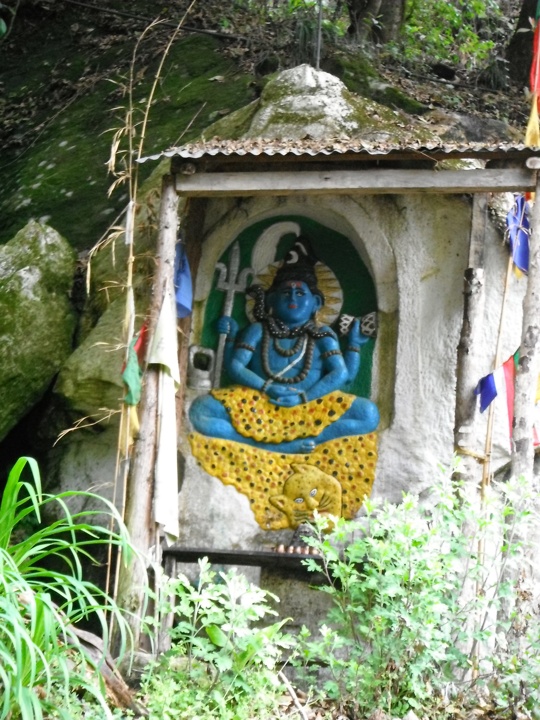 Day 7 walking – Shiva temple
 There really IS an ice cream van (or shop!) around the next corner!
Arriving in Rimbik in the late morning of day 7, we were fed momos and tea before the 3 hour car journey back to Darjeeling. Phew!
After checking in to hot showers we headed to the Windamere hotel for their high tea.
 Non-residents lounge at the Windamere
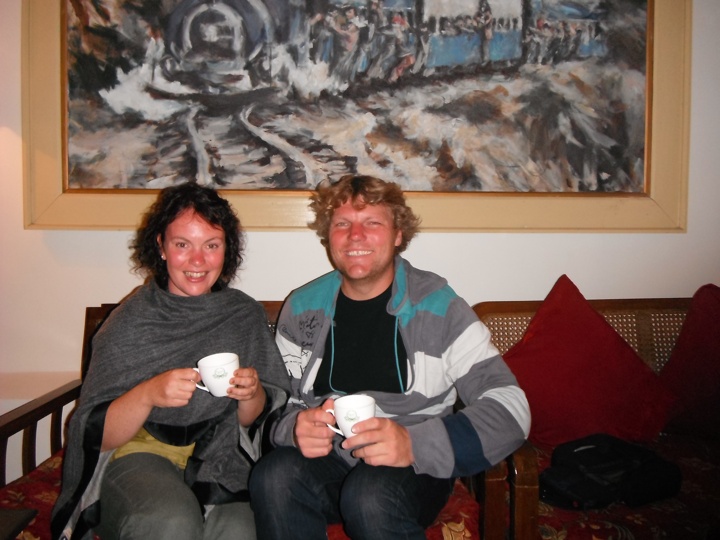 Drinking our Darjeeling tea
 Sandwiches, shortbread, marble cake, flapjacks and scones.
We finally got some sunshine on Sunday:
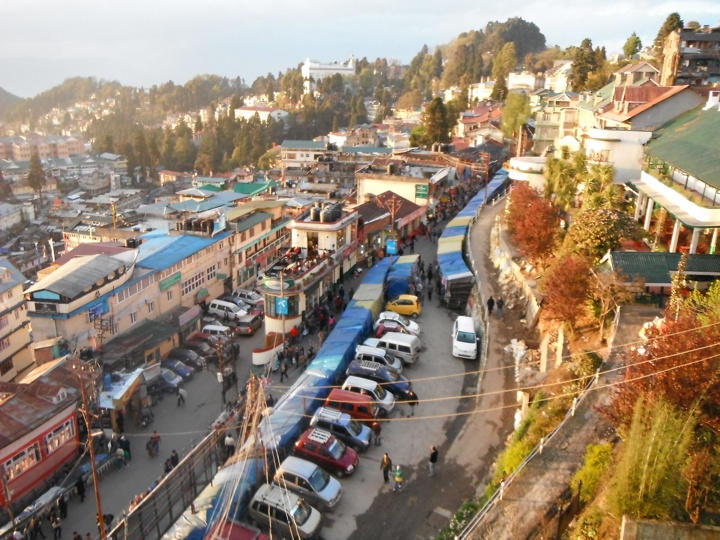 View from our hotel window
And on Monday we finally got the amazing view over the mountains that is so famous:
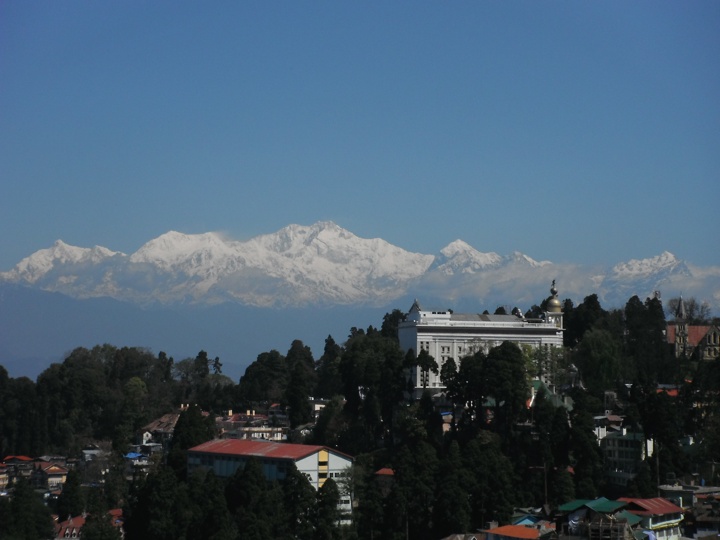

Before heading to Keventners for their savage breakfast:
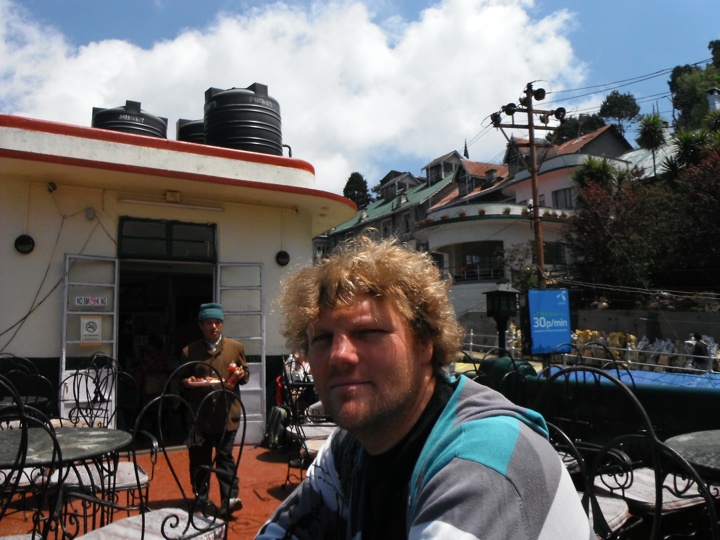 Happy man awaiting his breakfast.
 The BIG breakfast.
Between hair and beard Randall was starting to look more than a little scary so he had decided to have a shave and haircut by a local barber in the marketplace:
 The chair of doom.
 Something for the weekend, Sir?
 Randall getting in a lather
 Being brave…
 That’s a VERY sharp razor!
A very satisfactory result for less than a pound!
Now back down to the plains to catch the overnight train to Varanasi.
Sunday 1st – Thursday 5th April: Delhi
After a day of relaxing and some minor shopping on Connaught Place
 Tamsin outside the legendary Wengers on Connaught Circus (hello Charlie!)
and Janpath – FabIndia for pretty tops – on Tuesday we headed to Old Delhi’s Chandni Chowk to visit the wholesale spice market on Khari Baoli we’d been told about.
The remains of the gracious mughal city of Shahjahanabad can just about be traced behind the chaos of Delhi’s wholesale markets selling everything from paper to car parts, but the graceful courtyards and terraces have been filled with packed-in dwellings and shops housing the traders, rickshaw drivers and sweepers who live here, New Delhi’s down-at-heel neighbour, these days.
We took an autorickshaw to Chandni Chowk itself then persuaded Randall that it really would be OK for all three of us to get in a cycle rickshaw:
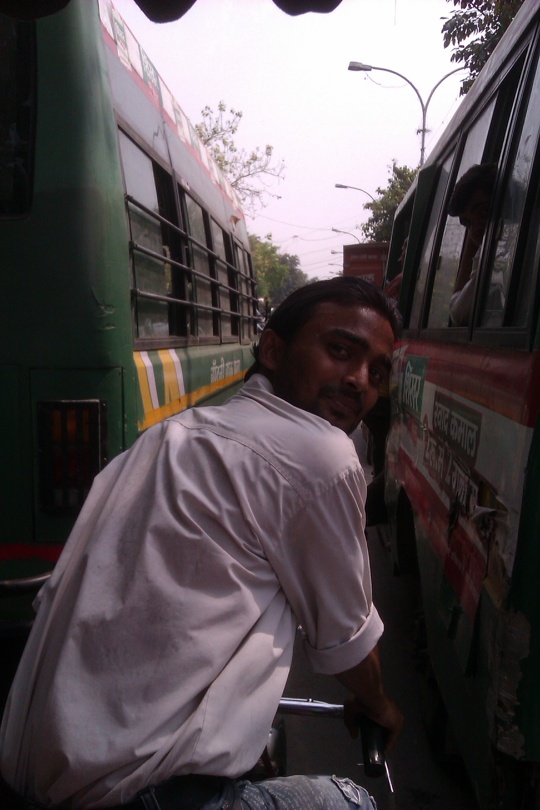 ‘Rocky’, ‘Rickshaw Pilot’ (his description!) trying to squeeze us between two buses.
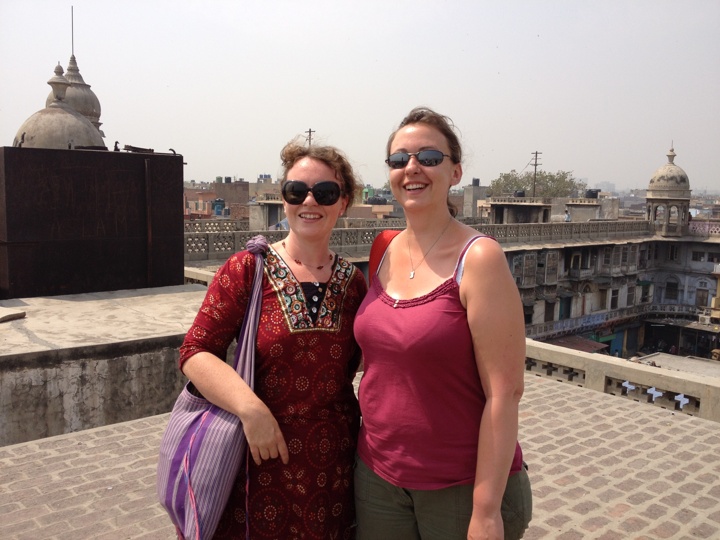
As luck would have it, ‘Rocky’ actually lived in one of the tiny one-room apartments in the chawls that have sprung up inside the spice market so knew his way around. He took us up onto the roof (via some terrifyingly precarious stairs) from where we could see down into the building itself on one side and the courtyard of the mosque on the other side.
 Top of the spice market – you can see the classic mughal-style building around the courtyard, and the warren of buildings cobbled together inside it.


To the far side is the mosque, where the courtyard looks more as these buildings were meant to be. Even there, the roof terraces have been put to use for drying flowers, herbs and spices:

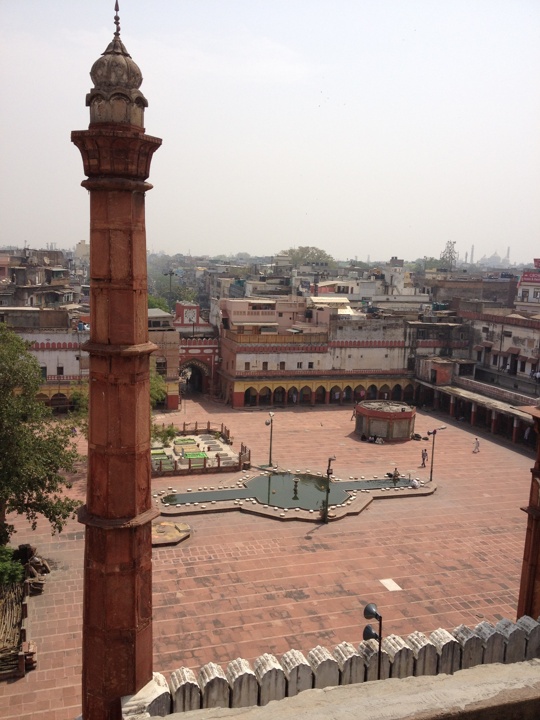
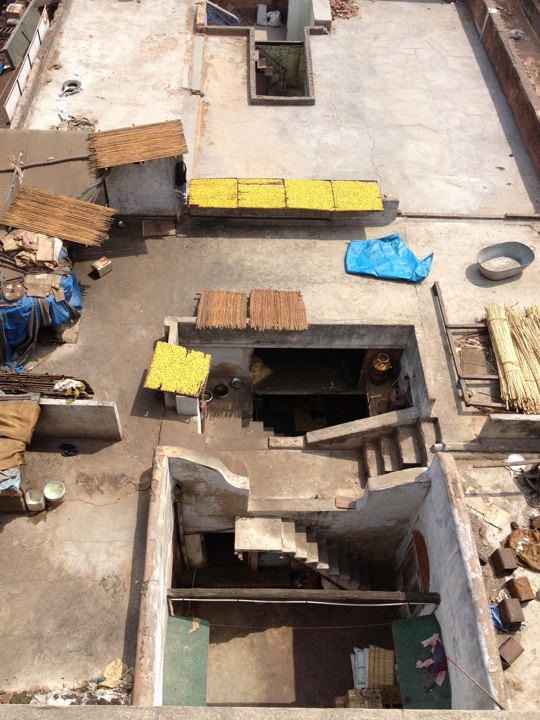 The old courtyards have been built up and filled in to house the hundreds of people who live and work in the building complex.
Inside the spice market building the air is filled with the aromas and powders of the herbs and spices, so your eyes water and throat itches. I can’t imagine what living there is like, although maybe you become immune to it.
The market was wholesale only, so Rocky brought us to a shop (where presumably he got a cut!) where Tamsin and I stocked up on everything from vanilla pods to turmeric root.

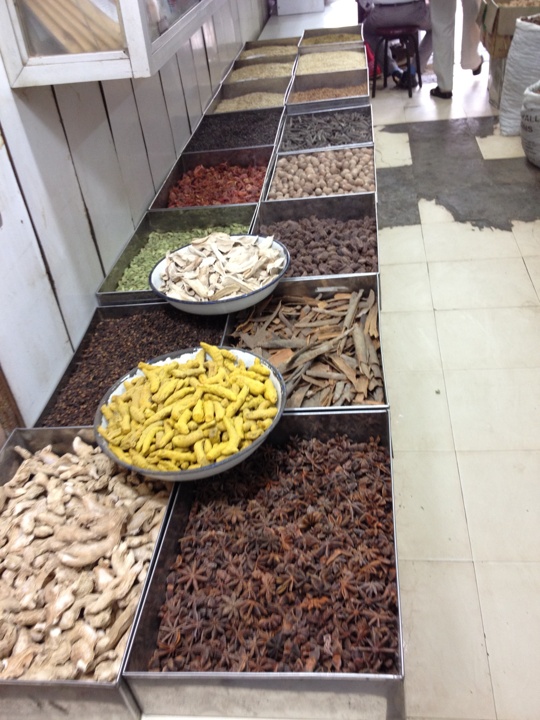
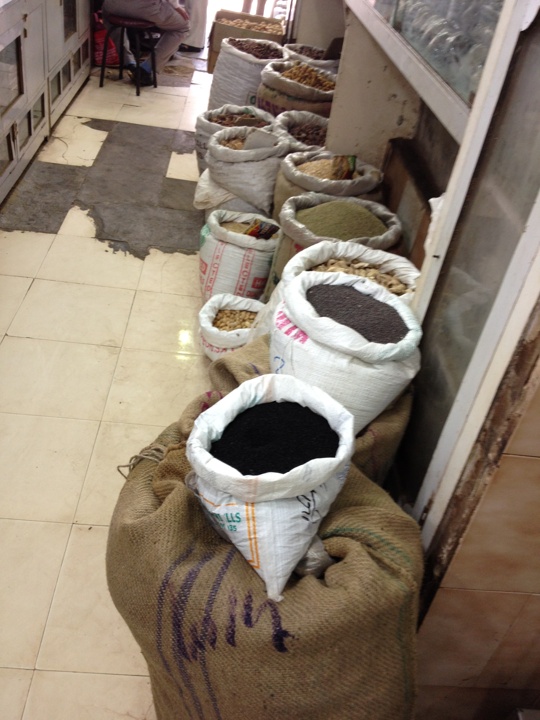
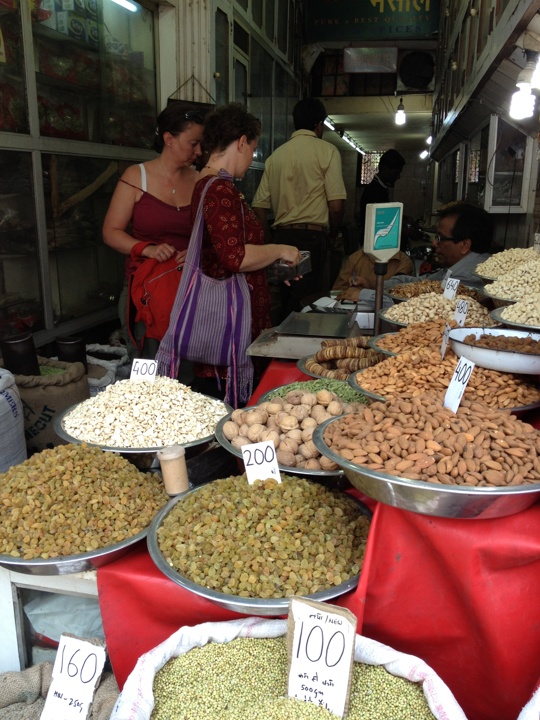 Checking out our purchases.
Tamsin and I wanted to go sari-shoppping (for decoration, not to wear) so Randall made his own way off and we got the ‘scenic tour’ of Old Delhi with Rocky’s running commentary, which was fun if occasionally a bit alarming. One of our favourite sights was this ‘school bus’ (of which we saw several) – a cycle-powered small cage with numerous tiny school-uniformed children stuffed (and locked) inside:
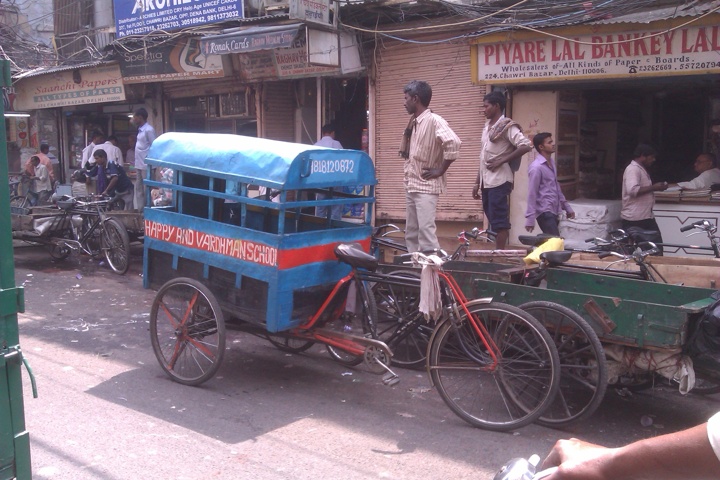
Shopping done, we headed back to Paharganj for lunch and to drop off some more tailoring (I’ve said it before, but I love how you can get ANYTHING fixed in India!) and to package up various things to be posted home. Quite exhausted from the heat and hecticness, the only answer was a night in watching TV and drinking the remains of our gin!
The next morning Tamsin and I were up early to visit Kairali, an Ayurvedic spa we’d been recommended by a woman we’d met in McLeod Ganj. We took the fabulous Metro out to Qutb Minar stop in Mehrauli – although this did involve having to shout at the security people to let us over the footbridge to reach the New Delhi metro station. Bizarre system – the only other way to reach it from the main thoroughfare Chelmsford Road is to go through the main station, which entails queueing with all the potential passengers to be security scanned and having ticket to travel. Classic bureaucracy-gone-nuts.
Still, the Ayurvedic centre was very relaxing:
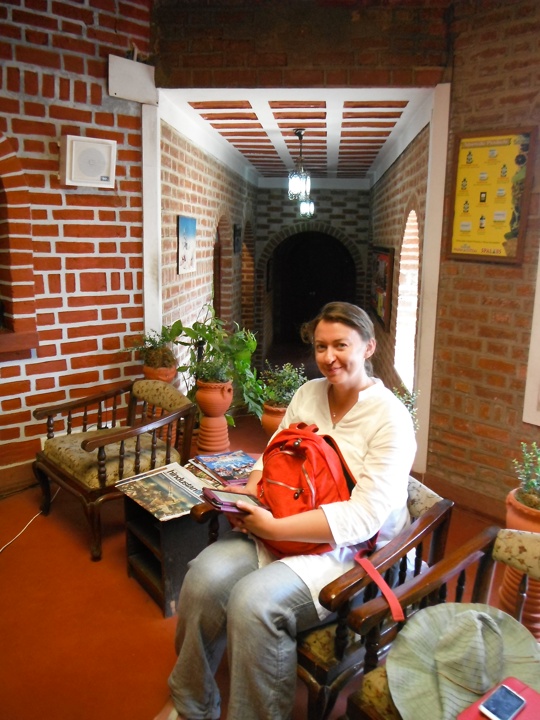 Tamsin in the reception of Kairali, just before we both had Elakizhi treatments.
After the treatment – quite unlike anything either of us had had before, with two therapists really going for it with the firm massage and battering with herb-filled muslin bags – we both felt shiny and invigorated, and ready for lunch.
We met Randall at Basil & Thyme, a restaurant recommended to us by Christopher, who was sadly unable to join us. It was a lovely restaurant – all smoked salmon carpaccio and light Mediterranean main courses – a bit River Cafe, although sadly no wine as it’s not licensed. The glamorous maitress d’ even told us where the recipe for the delightful strawberry and cinnamon torte came from.
Randall headed off while Tamsin and I nipped to the salon next door for a leg-and-other-bits wax. This turned out to be an interesting experience as, before either of us realised what was happening, we had got rather more (or, indeed, less) than we had bargained for. Some cultural differences really are quite unexpected and enlightening!
To round off Tamsin’s trip we went to meet Daleep and the elusive DJ (both friends from when Charlie and I were first in India) at Aqua, the poolside bar at The Park Hotel. Nice bar, good music, good mezze menu, but the most uncomfortable selection of furniture! A good night of catching up on the past and planning for the future, topped off by Daleep having to leave because his twin sister had just gone into labour! DJ drove us back to Paharganj, very nobly not turning his nose up (much!), for a few hours sleep before an early start for the airport.
Randall and I dropped Tamsin off at the International terminal before catching our flight to Bagdogra for Darjeeling. This made us laugh:
 Casual (or indeed overt) sexism of any kind not dead here yet!
Thursday 29th March – Sunday 1st April: Jim Corbett National Park
This is our beautiful lodge accommodation at Jim’s Jungle Retreat, Daleep’s lodge in Corbett National Park. The lodge accommodation is upstairs, with the downstairs sections being ‘researcher accommodation’ or in some cases not yet developed. You can just about spot the solar water heaters on the roof – they take their eco-credentials pretty seriously.

Inside, the rooms are beautifully furnished and decorated…

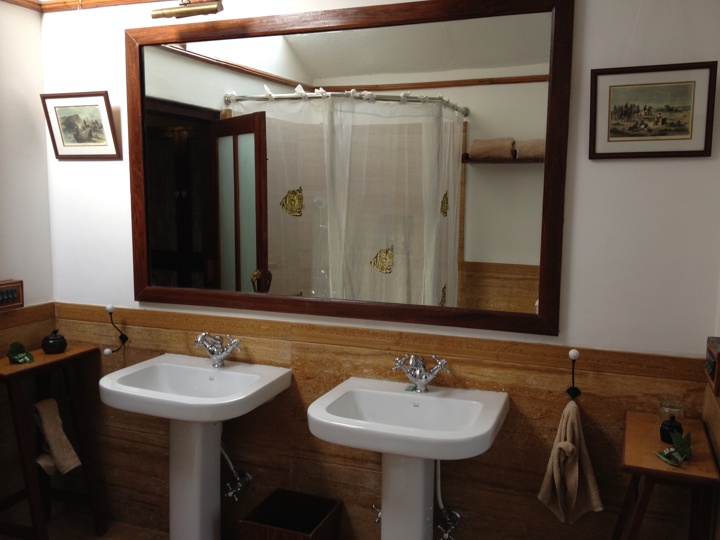
…with beautiful fabrics and textiles designed by Daleep’s twin sister, and lovely touches like this funky antique phone (that worked of course) and photos, either wildlife ones (mostly taken by Inder, Daleep’s dad) or historical ones related to the park.

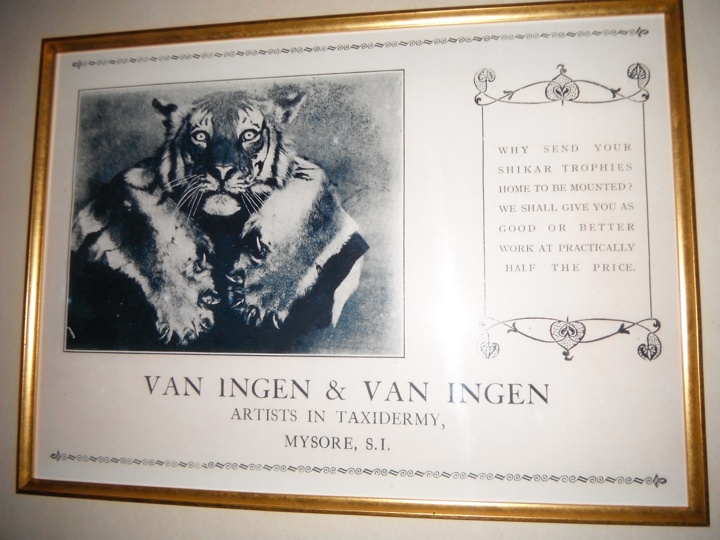 Why send your trophies home for taxidermy?
 The seating area on our verandah – perfect for sundowners.
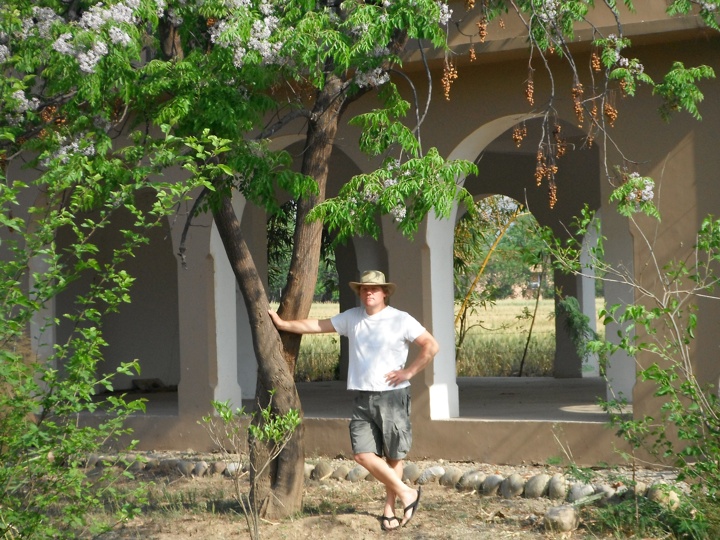 Steve Irwin reincarnated?
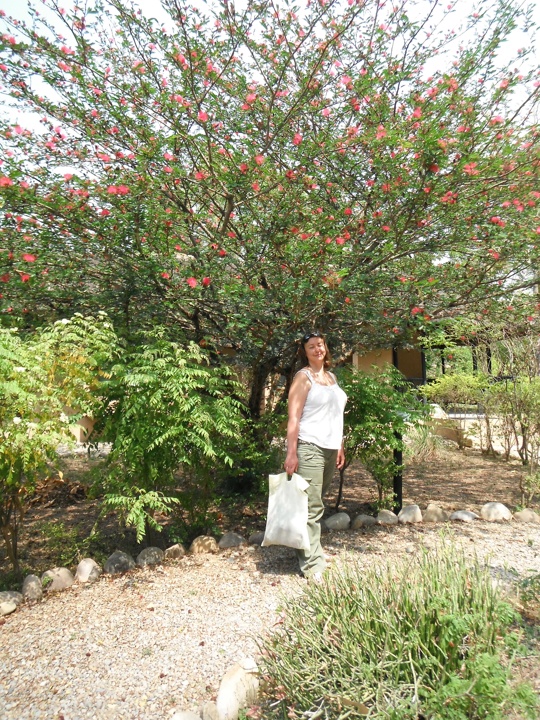 Tamsin posing on one of the winding paths around the property.
When they started building the property it was all cultivated fields, so they consulted a naturalist and a botanist to get the right mix of plants and trees for the grounds. The result is a series of shady pathways with the odd hammock slung between trees; not too manicured but very pretty.
We woke up early on our second day for the dawn jeep safari to Jhirna, the nearest reserve area in the park, we left before dawn which meant we saw the beautiful sunrise over the forest as we were entering the reserve.

Our guide was fantastic, particularly once he realised that – unlike many of the visitors to Corbett – we weren’t only obsessed with seeing a tiger. After that he went out of his way to point out all the other wildlife, including some amazing birdlife. We saw a kingfisher dive from midair for a fish – incredible. He was also good at identifying sounds – we heard a leopard calling to another across a dry river – and spotting animal sign:
 Recent tiger prints!
 This astonishing tree on the way to Jhirna from the lodge had over 60 bees’ nests in it.
 Langur being, well, languorous .
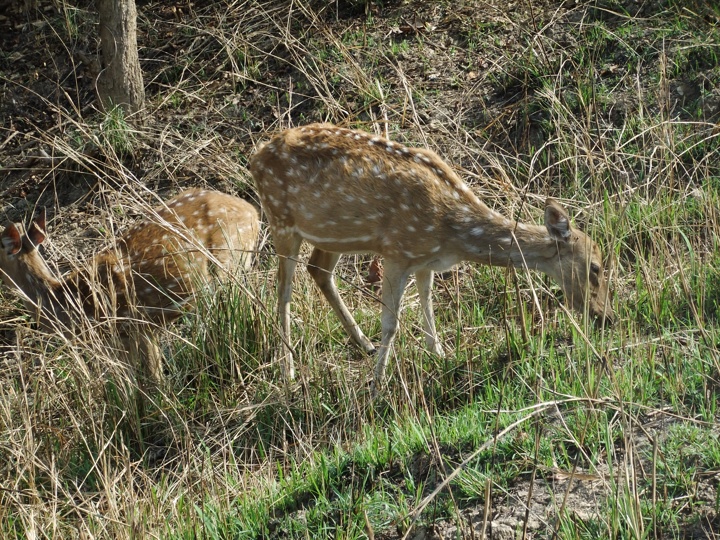 Spotted deer. We also saw barking deer and sambar.
 One of the hides managed by the forest reserve staff (a bit ricketty!)
 Trying to spot (ha ha) the leopard we could hear.
The reserve closes to visitors at 10am (opening again later) so we were driven back to Jungle Jim’s in time for breakfast and a little light nap before leaving for our sunset safari to Bijrani reserve, this time a half-hour drive from the lodge with only our driver from Jim’s, as we were to pick up a forest reserve guide at the entrance to the reserve (them’s the rules).
This sign amused us on the way:

Here we are looking intrepid:
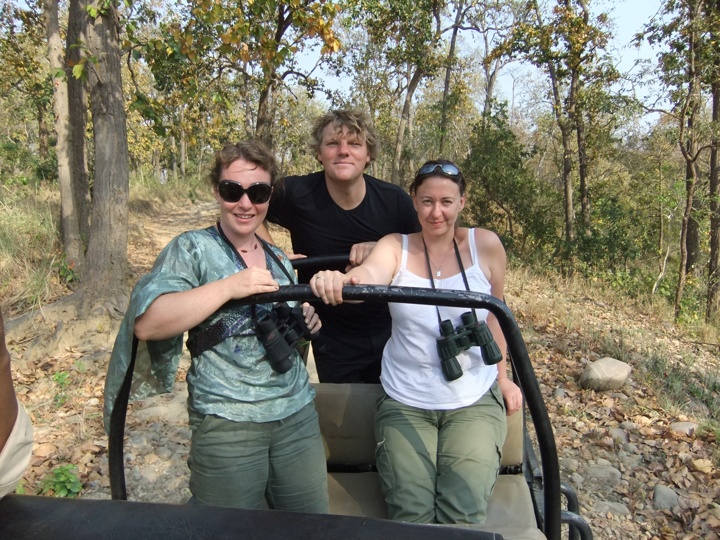

On this safari our guide was less interested in other wildlife and definitely a tiger-hunter. We still spotted plenty of cool birds including a jungle owlet and a brown fish owl, plus a mongoose, loads of deer and monkeys – both langurs and the ubiquitous rhesus macaques. The highlight was being only a few metres away from two tigers – we couldn’t see them as they were in a dry river bed not visible through the undergrowth from the road, but we listened to them growling for about half an hour. It was eerie; after the warning calls from the langurs and barking deer the entire area of forest went completely silent except for the tigers.
When we arrived back at the exit of the reserve we spotted a jungle cat too, which was beautiful (apparently they have been cross-breeding with the local domestic-type moggies) but a couple of the other people waiting there showed us a photo of the tiger we had been listening to shortly before we arrived – it crossed the road right in front of them…eek!
When we were almost back at the lodge we saw a couple of jeeps had stopped at the side of the road – it turned out that a herd of wild elephants was feeding just a few metres into the forest; a small tusker plus the matriarchal group, a couple of young and two nursing babies…SO CUTE!
 Don’t mess…
The next day was a bonus extra – we’d been planning to head to Delhi but we were invited to stay another night as we hadn’t really had time to catch up with our hosts. We spent the day doing some really hardcore relaxing:
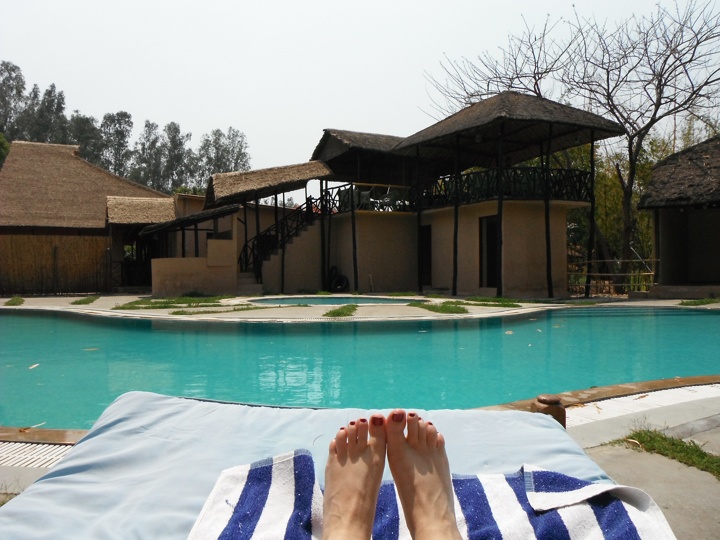
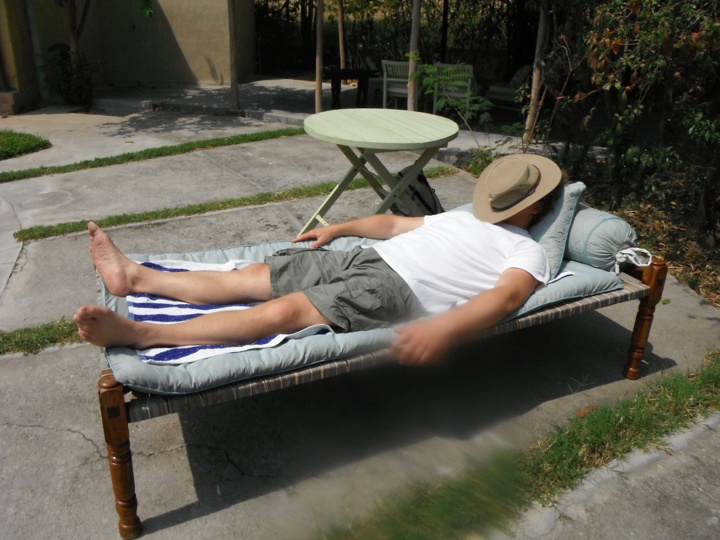
 Evening G&T on the verandah, before Inder summoned us to pre-dinner drinks with him by banging two bottles together. How well he had got to know us in such a short time!
After a lovely evening chatting, eating and drinking around the pool we retired as we had another early morning safari – this one a walking safari in the area around the park. We didn’t see anything big – plenty of deer, monkeys and birds though, and it was a glorious morning walk and sunrise.
Finally it was time to pack, have breakfast, and then head for Delhi by car.
The rest of the photos are here:

 Helen and Randall on the road